


Do Google Reviews Help SEO? What They Influence and What They Don’t

Yes, Google reviews help SEO, mainly local SEO. Google says more reviews and positive ratings can improve a business’s local ranking, and reviews also change how many searchers click, call, and trust you once you appear.
Reviews will not make up for a weak website or an incomplete Google Business Profile, and they do not guarantee a Map Pack spot. This guide explains what reviews influence, what they don’t, and how to earn more of them within Google’s rules. It ends with a 30-day plan you can start on Monday.
- Google confirms that review count and ratings can improve local ranking. Review velocity and keywords in reviews come from industry studies, not from Google.
- Reviews affect Map Pack and Google Maps rankings directly. In organic results, their effect is mostly indirect: clicks, conversions, and brand searches.
- Reviews give customers and Google’s quality raters evidence of real experience, which supports E-E-A-T. E-E-A-T is not a single ranking factor.
- Earn reviews with one consistent request process. Never gate, incentivize, or fake them.
- Reply to every review, and track your count, rating, and monthly pace against nearby competitors.
This post is part of our Reputation & E-E-A-T hub. Below, we label each claim as confirmed by Google, an industry finding, or our best-practice advice. If you need the broader definition first, start with what reputation management in SEO means.
How Google Reviews Relate to Local Rankings
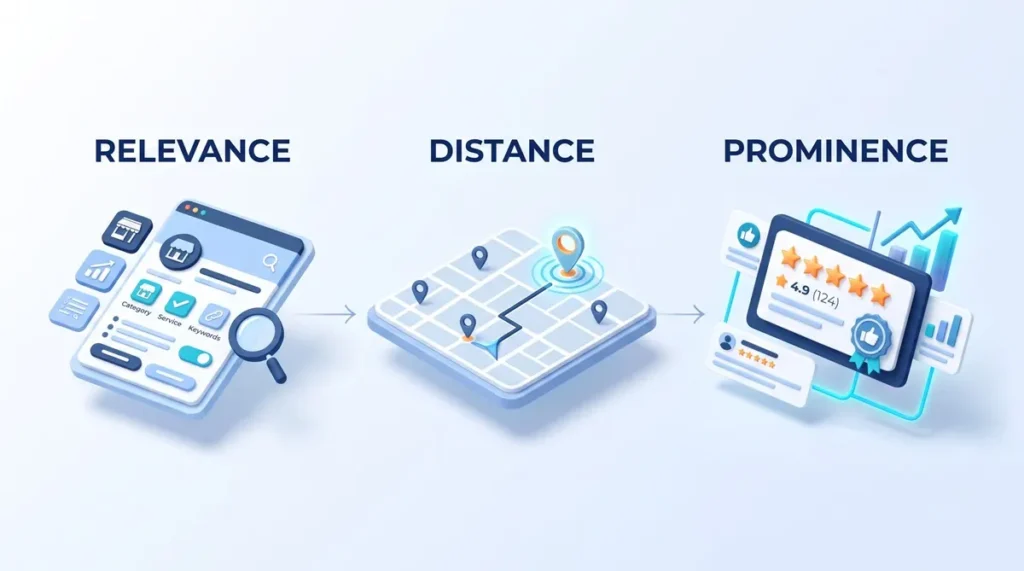
Google describes local ranking with three factors: relevance, distance, and prominence. Reviews are part of prominence. Google’s guidance on local ranking says prominence reflects details such as how many reviews a business has, and that more reviews and positive ratings can improve local ranking.
That is the confirmed part. Google has not published weights or formulas, so the rest of this section reflects industry research and practitioner testing.
Quantity and rating (confirmed by Google)
Review count and average rating both contribute to prominence. Practitioners find that a business with a handful of reviews rarely outranks a competitor with a long, steady history, even when the smaller business has the higher score.
Recency and velocity (industry findings)
Review velocity is how fast new reviews arrive. Surveys of local SEO professionals list review recency and velocity among review signals, though Google has not said how it measures either. Many practitioners find that a steady monthly flow looks more natural than 30 reviews in a week followed by months of silence.
Keywords in review text (industry findings)
Customers describe the work in their own words: “emergency roof repair,” “same-day crown,” “custody mediation.” Studies and practitioners suggest those terms may help a business appear for related searches, and Google Maps shows topic highlights drawn from review text.
Do not script this. Google’s policy warns against attempting to influence the content of a review, so never ask customers to use particular phrases. Ask right after the work is done, and customers will name the service on their own.
Owner responses (Google guidance; ranking effect unconfirmed)
Google says replying to reviews shows customers you value their feedback, and that positive reviews with helpful replies can help your business stand out. Google has not confirmed that replies directly change rankings. Their clearest effect is on the people reading them.
Reviews and the Map Pack vs. Organic Results
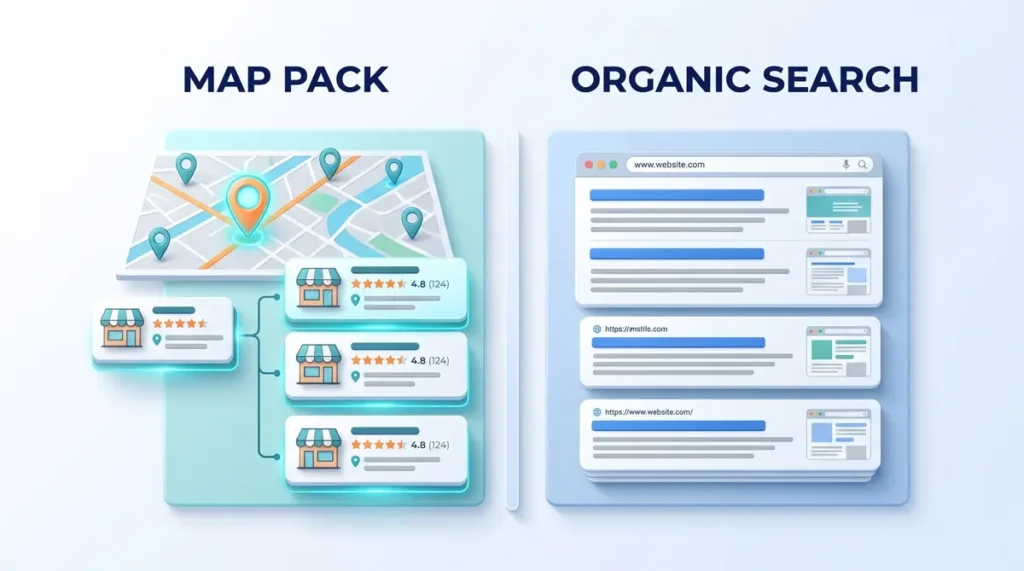
In the Map Pack and Google Maps, reviews are both a ranking input and a visible comparison tool. Stars and review counts appear beside your name, so searchers compare you with competitors before clicking.
Organic results work differently. Google notes that your position in web results also factors into local ranking, so standard SEO still applies. Reviews do not directly rank your service pages. A roofer with hundreds of reviews and a thin website will still struggle to rank organically for “roof replacement” searches.
Reviews can still reach organic results in two ways:
- Third-party review sites. Yelp, Healthgrades, Avvo, and Angi pages often rank for “[business name] reviews” searches.
- Reviews on your own site. Review schema is a separate matter: Google limits star snippets for self-serving reviews of local businesses, so verify its current structured data guidelines before adding markup.
Indirect SEO Benefits: Clicks, Conversions, Trust, and Brand Searches
Where reviews do not move rankings, they change what happens after you rank.
- Click-through rate. Searchers choosing among three businesses use stars and counts as the fastest comparison.
- Conversions. Visitors who read reviews before calling arrive with more trust and fewer objections, so the same ranking position produces more booked jobs.
- Engagement. Practitioners debate whether Google uses calls or direction requests as a direct local ranking input. Either way, the business result is more contact from searchers.
- Brand searches. Customers who read good reviews often search for your business by name later. Many practitioners treat growing branded search as a sign of rising prominence, though Google has not confirmed it as a ranking input.
Reviews and E-E-A-T
E-E-A-T stands for experience, expertise, authoritativeness, and trustworthiness. Google has said it is not a single ranking factor; it is a framework in the guidelines Google gives its quality raters. Those guidelines tell raters to research a business’s reputation using independent sources, and customer reviews are one such source.
Reviews support two of the four letters:
- Experience. A review describing a specific job, such as a water heater replacement or a dental crown, is first-hand evidence that the business did the work.
- Trust. A long history of independent ratings, with visible owner replies, shows that real customers used the business and how it handles problems.
This matters most for healthcare, legal, and financial topics, where Google applies higher scrutiny. Reviews are one trust signal among several; see how to build trust signals for the rest. Independent coverage complements them: reviews show customers trust you, and coverage shows others noticed your work. A local press release can support that when it announces real news, and our guide to PR and SEO strategy explains how.
What Reviews Do Not Do
- A high rating does not guarantee a top spot. A highly rated business far from the searcher can lose to a closer, relevant one with fewer reviews.
- Reviews do not fix a weak profile. A wrong primary category, missing services, or an inconsistent name, address, and phone number will limit your rankings no matter how many reviews you have.
- Arguing does not remove a negative review. Google removes reviews only when they violate its content policy, and you can flag those.
- A perfect 5.0 is not the goal. Many practitioners find shoppers distrust flawless ratings, and a few critical reviews with professional replies read as authentic.
- Bought reviews do not work. Google removes fake reviews and may restrict profiles that repeatedly violate its fake engagement policy.
How to Earn More and Better Reviews (White Hat Only)
Start with Google’s rules. The Maps contributed content policy says reviews should reflect a genuine experience. In practice that means:
- No incentives. Google prohibits offering payment, discounts, or free goods or services in exchange for a review, or for revising or removing a negative one.
- No gating. Do not screen customers and send only the happy ones to Google. Industry coverage reports that the policy also bars selectively soliciting positive reviews or discouraging negative ones, so confirm the current wording.
- No fake reviews. Do not write reviews of your own business, and do not ask staff or relatives to. In the United States, the FTC’s rule on consumer reviews and testimonials also bans buying fake reviews and publishing insider reviews without clear disclosure.
- No steering. Do not ask for five stars or for specific wording.
Then build a repeatable process (our best-practice recommendations):
- Ask every customer, not just the ones who seem pleased.
- Ask when the experience is fresh: right after the job, appointment, or meal.
- Make it one tap. Send your Business Profile’s direct review link by text or email, or print a QR code on invoices and receipts.
- Ask in person too. A technician or front desk hand-off often works better than an email.
- Follow up once, politely, then stop.
- Check consent rules for texts and emails in your country before automating requests.
If you would rather not run this yourself, our reputation and brand management services can handle review requests, monitoring, and replies for you.
How to Respond to Reviews, Including Negative Ones
Reply to every review, ideally within two business days. Name something specific, keep it short, and never include private details or argue.
Positive review (example):
“Thank you, Maria. We’re glad the new water heater was running the same day you called. If anything changes, call us at [phone].”
Negative review (example):
“Thank you for telling us, James. Waiting 90 minutes past your appointment time is not our standard, and we’re sorry. Please call our office manager at [phone] so we can look into what happened and fix it.”
Review you can’t match to a customer (example):
“Hello, we couldn’t match this review to a job in our records. Please call [phone] with the date and address of service so we can look into it.”
Clinics and law firms: do not confirm that a reviewer is a patient or client, even in a reply. Keep replies general and check with your compliance counsel. If a review is fake or breaks Google’s policy, flag it through your Business Profile and keep a record.
Common Mistakes
- Asking only happy customers, which is gating.
- Collecting a burst of reviews, then going quiet.
- Ignoring negative reviews or answering defensively.
- Pasting the same reply under every review.
- Stuffing keywords into replies (“Thanks for choosing the best roofer in Phoenix”).
- Tracking only the star rating, not count, pace, and competitors.
- Treating reviews as the whole strategy while the website and profile stay incomplete.
Your 30-Day Review Action Plan
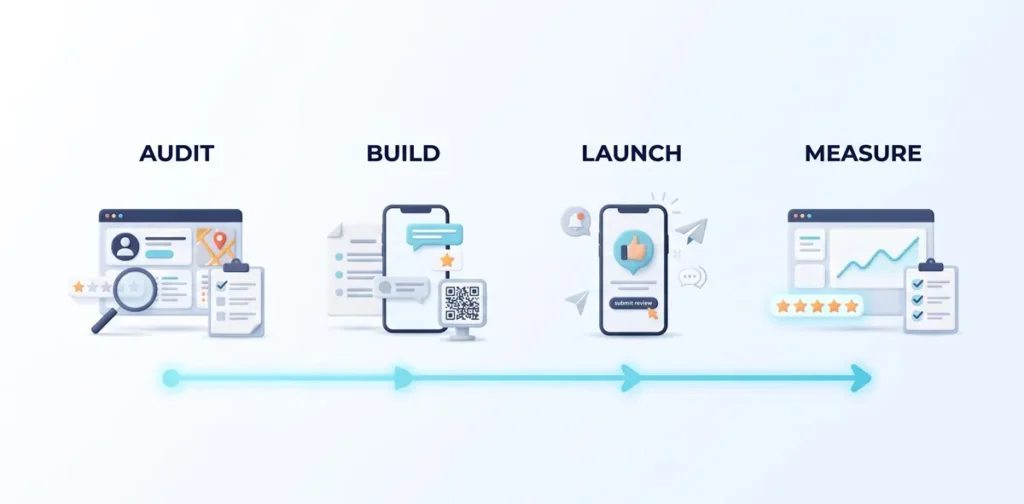
Week 1: Audit
- Record your review count, rating, and reviews from the last 30 days for you and the top three Map Pack competitors.
- Confirm your profile is verified, your primary category is correct, and your name, address, and phone number match your website.
- Copy your direct review link and generate a QR code.
- Reply to every unanswered review.
Week 2: Build the process
- Write a short request message and an in-person script that asks for an honest review.
- Choose when each customer type gets asked: job complete, visit complete, or invoice paid.
- Train staff on the do-not list: no incentives, no gating, no steering.
Week 3: Launch
- Ask every customer using the new process.
- Reply to new reviews within two business days.
- Flag any review that breaks Google’s policy.
Week 4: Review and set a pace
- Compare your new count, rating, and pace with your Week 1 numbers.
- List the themes customers mention, praise and complaints, and fix one complaint.
- Set a monthly review target based on what competitors earn.
Frequently Asked Questions
Do Google reviews help SEO?
Yes, mainly local SEO. Google states that more reviews and positive ratings can improve a business’s local ranking. Reviews also increase clicks, calls, and trust once you appear. They do not directly rank your website’s service pages in organic results, so pair reviews with solid on-page SEO.
Is review count or star rating more important?
Both count, and Google names review count and score as inputs to prominence. Many practitioners find a steady volume of recent reviews matters more than a perfect score. A 4.6 with consistent new reviews often reads as more credible than a 5.0 from a handful of customers. Neither replaces relevance and proximity.
What is review velocity, and does it matter?
Review velocity is how often new reviews arrive. Google hasn’t published how it uses it, but industry studies and practitioners link steady, recent reviews with stronger local visibility. A sudden burst followed by silence looks unnatural to shoppers and may draw scrutiny. Aim for a consistent pace tied to completed jobs.
Does responding to reviews improve rankings?
Google says replying shows customers you value their feedback, and that positive reviews with helpful replies can help your business stand out. Google has not confirmed that replies directly change rankings. Replying still earns trust from readers, resolves complaints publicly, and costs nothing, so respond to every review.
Can I offer a discount for a Google review?
No. Google’s Maps policy prohibits offering incentives such as payment, discounts, or free goods and services in exchange for reviews. Violations can lead to removed reviews and restrictions on your Business Profile. Ask every customer for an honest review, and thank them afterward with words, not rewards.
How many Google reviews do I need to rank?
There is no set number. Rankings depend on relevance, distance, and prominence, and the review count you need depends on what competitors near you have. Compare your count, rating, and recent review pace against the top three Map Pack businesses for your main search, then set a monthly target that matches or beats their pace.
Google reviews help local SEO through ranking inputs Google has confirmed, and through clicks, conversions, and trust that no ranking report shows. They work best alongside a complete Business Profile and a sound website, and only when you earn them within Google’s rules.
Start with the 30-day plan above. If you would rather have a team run review requests, replies, and monitoring, our reputation and brand management services are built for that.