
What Actually Puts a Local Business Inside the AI Answer
We ran one editorial signal across four markets, tracked two ongoing accounts week by week, then pointed the same method at our own brand. Here is every result, including the query where it did not work.
The move we were testing for. Not a ranking underneath the answer, but a named position inside it.
Ranking Under an AI Answer Is Not the Same as Being In It
A local “who is the best” search increasingly resolves before anyone reaches a list of links. Research from the Pew Research Center found that when an AI-generated summary appears on a Google results page, users click a traditional result in 8% of visits against 15% without one, and click a link inside the summary itself only about 1% of the time (Pew Research Center, 2025). The answer text is doing the recommending. The links underneath it are increasingly decorative.
That reframes the job. Ranking well is still worth having, but for a business competing on “best roofer in…” or “best dentist in…” queries, the outcome that decides the lead is whether the model types your name. Our Editorial Placements service was built specifically for that outcome. This study is what happened when we stress-tested it.
We wanted four things answered before we treated it as a dependable lever rather than a promising one.
- Does a live placement move a business into the AI Mode and AI Overview answer for the exact query it targets, and how fast?
- Does that hold across unrelated industries and more than one placement format, or was the first result a coincidence?
- On an account already running a full AEO program, do AI citations keep accumulating week over week, or does the count flatten after the first mention?
- Does it work on our own brand, and are we willing to publish the queries where it does not?
Publish the Comparison the Model Is Already Looking For
Top of the list, by design
Editorial Placements come in three formats: City Best-Of, Local Listicle, and Top 3 Comparison. Each runs on a partner publication under an independent editor's byline rather than being pitched cold to a publisher who may never accept it. This study used two of the three, City Best-Of for three trials and a Top 3 Comparison for the fourth. In every case the business holds the first position, because models weight the opening entries of a comparison far more heavily than an entry buried three screens down.
Formatted for extraction, not just for reading
Each article ships with a structured comparison table and explicit selection criteria: short labelled rows rather than long paragraphs. The effect of that formatting is visible in the answer itself. In the capture below, Google's AI Mode did not simply cite the article as a source. It rebuilt the placement's own comparison table inside the answer panel, column headings and all.
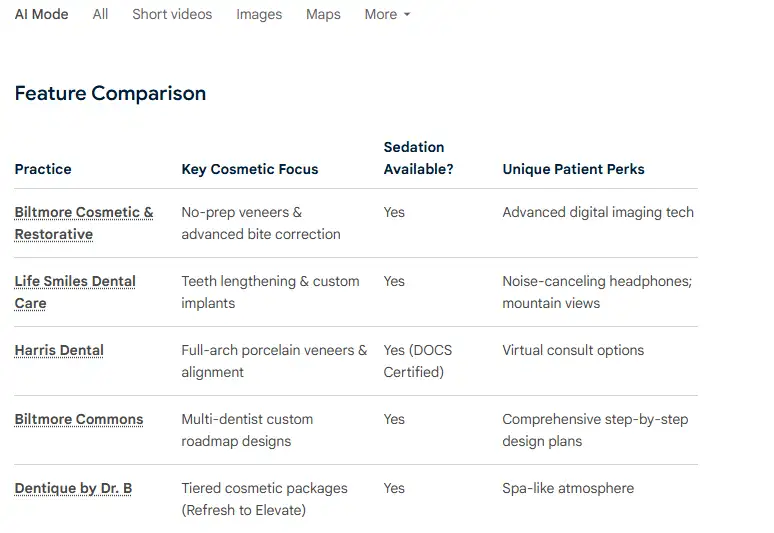
Why this detail matters. A citation is the model pointing at your article. Extraction is the model repeating your article. The second one survives even when the searcher never clicks anything, which, per the Pew figures above, is most of the time.
Four Markets, Four Placements, One Pattern
Each query was checked directly in Google AI Mode and AI Overviews before the placement went live, then again after. Two of the four businesses were not mentioned at all to begin with.
“Best Cosmetic Dentists in Phoenix, AZ”
City Best-OfMoved four positions in 6 days, the fastest of the four.
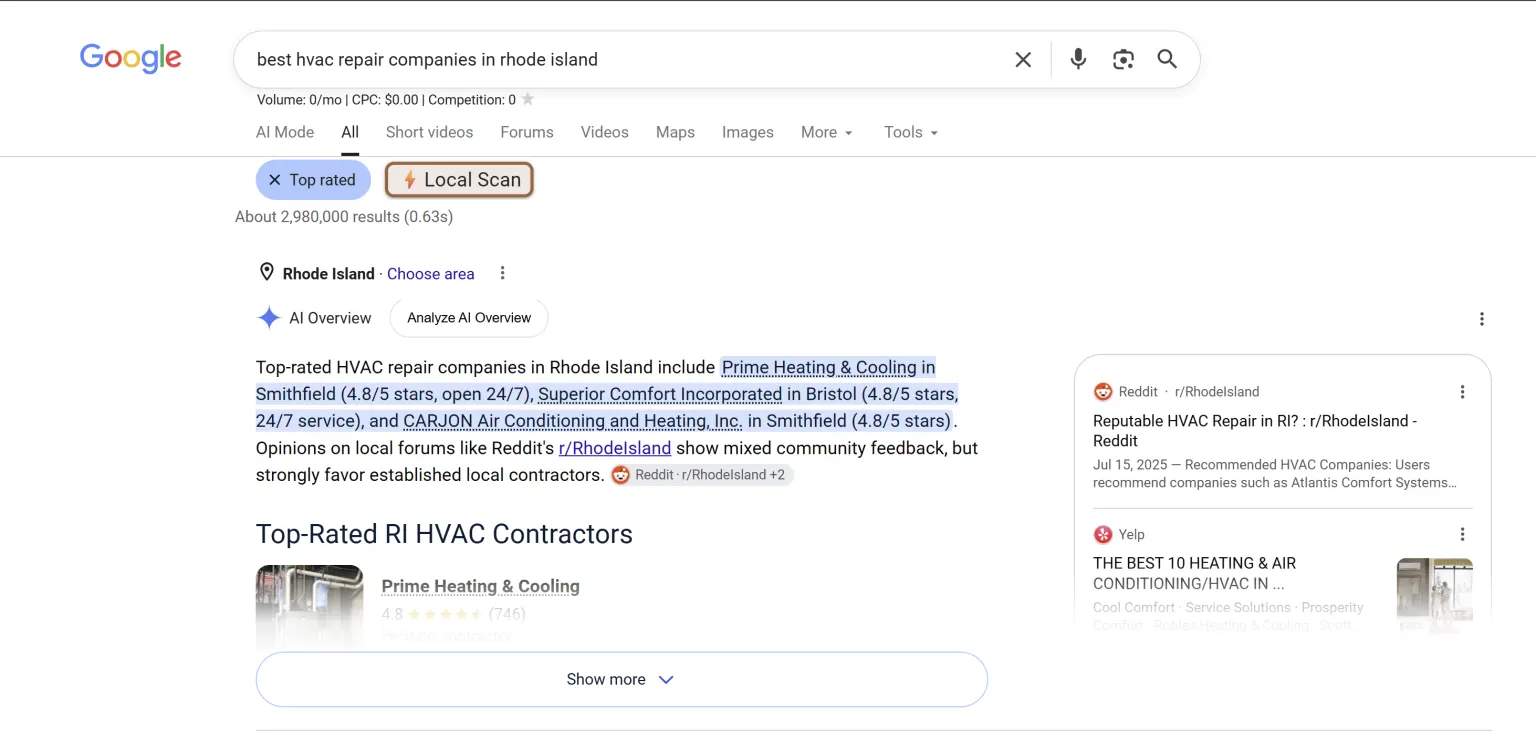
“Best HVAC Repair Companies in Rhode Island”
City Best-OfA statewide rather than single-city query, landed in 13 days.
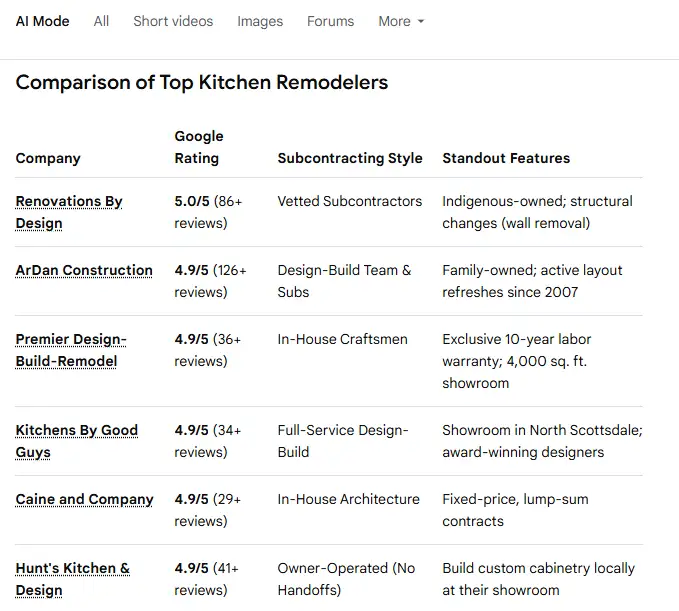
“Best Kitchen Remodeling Companies in Scottsdale, AZ”
City Best-OfFrom no mention at all to the lead entry in 16 days.
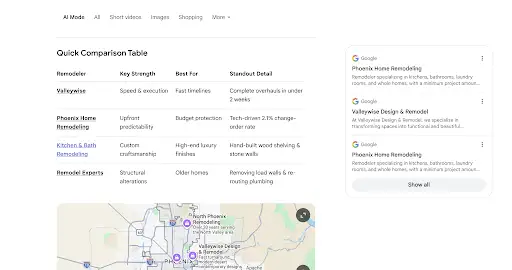
“Best Kitchen Remodeling Contractors in Phoenix”
Top 3 ComparisonThe only Top 3 Comparison in the set, live in the answer in 8 days.
One Placement Is an Event. An Account Is a Curve.
Four before-and-after snapshots prove a placement can move a specific query. They say nothing about whether AI citations accumulate the way organic rankings do, or whether a business gets one mention and stalls. To look at that, we pulled recent weekly Search Atlas LLM Visibility reports for two law firm clients who are not running a single placement in isolation, but the full connected program described on our AI SEO services page: editorial signals layered over llms.txt, answer-first content structure, and schema for AI search.
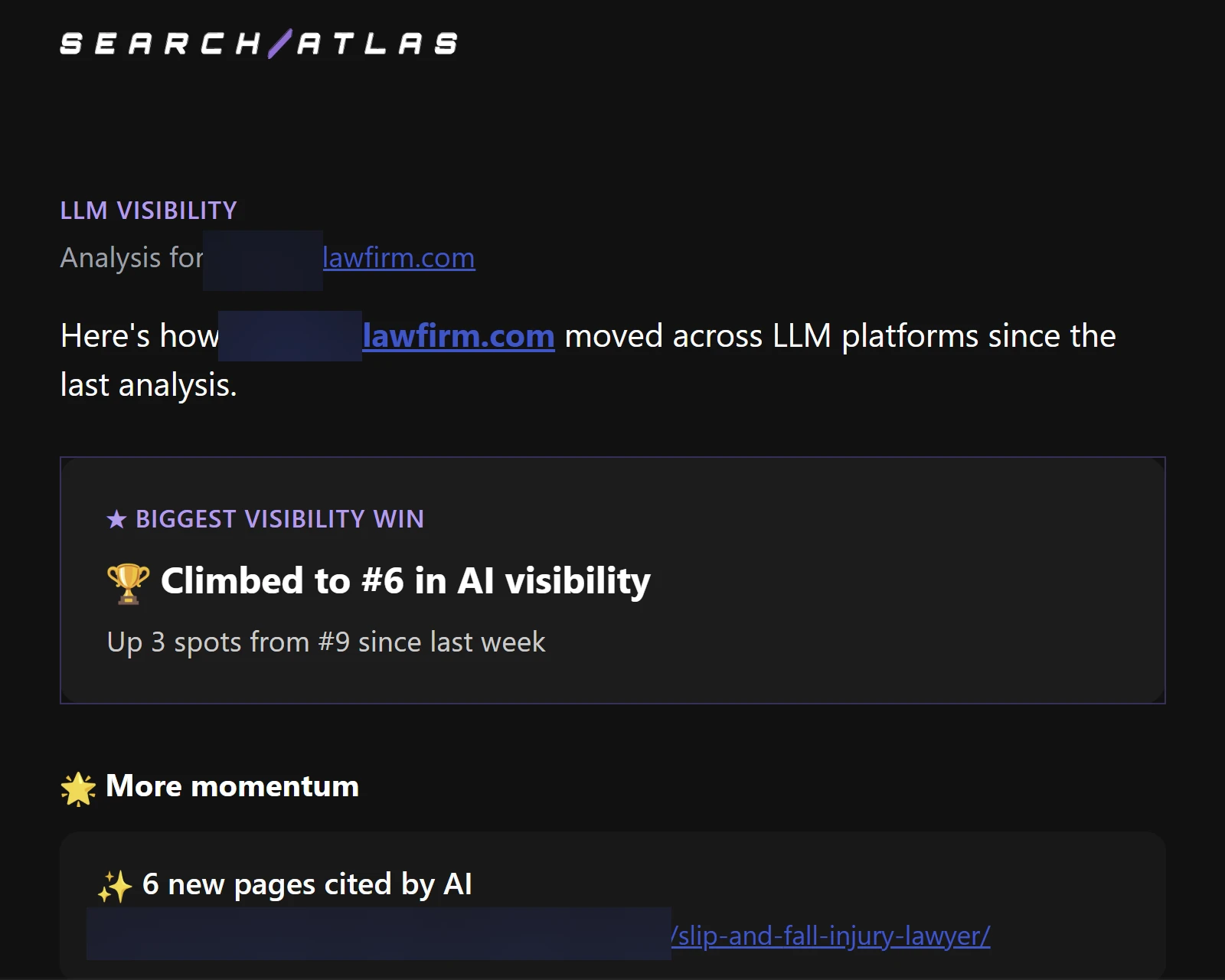
Firm A: moving up the visibility ranking
This firm's AI visibility ranking climbed to #6 across the LLM platforms Search Atlas tracks, up three places from #9 the previous week, with six new pages picked up as AI citations in the same period, including a practice-area page built around slip and fall injury searches.
Firm B: citations stacking week over week
A second firm posted its strongest tracked week so far: nine new pages cited by AI within a single week, its largest jump to date, with cumulative citations of the firm's site reaching 123 across the same platforms and rising week over week.
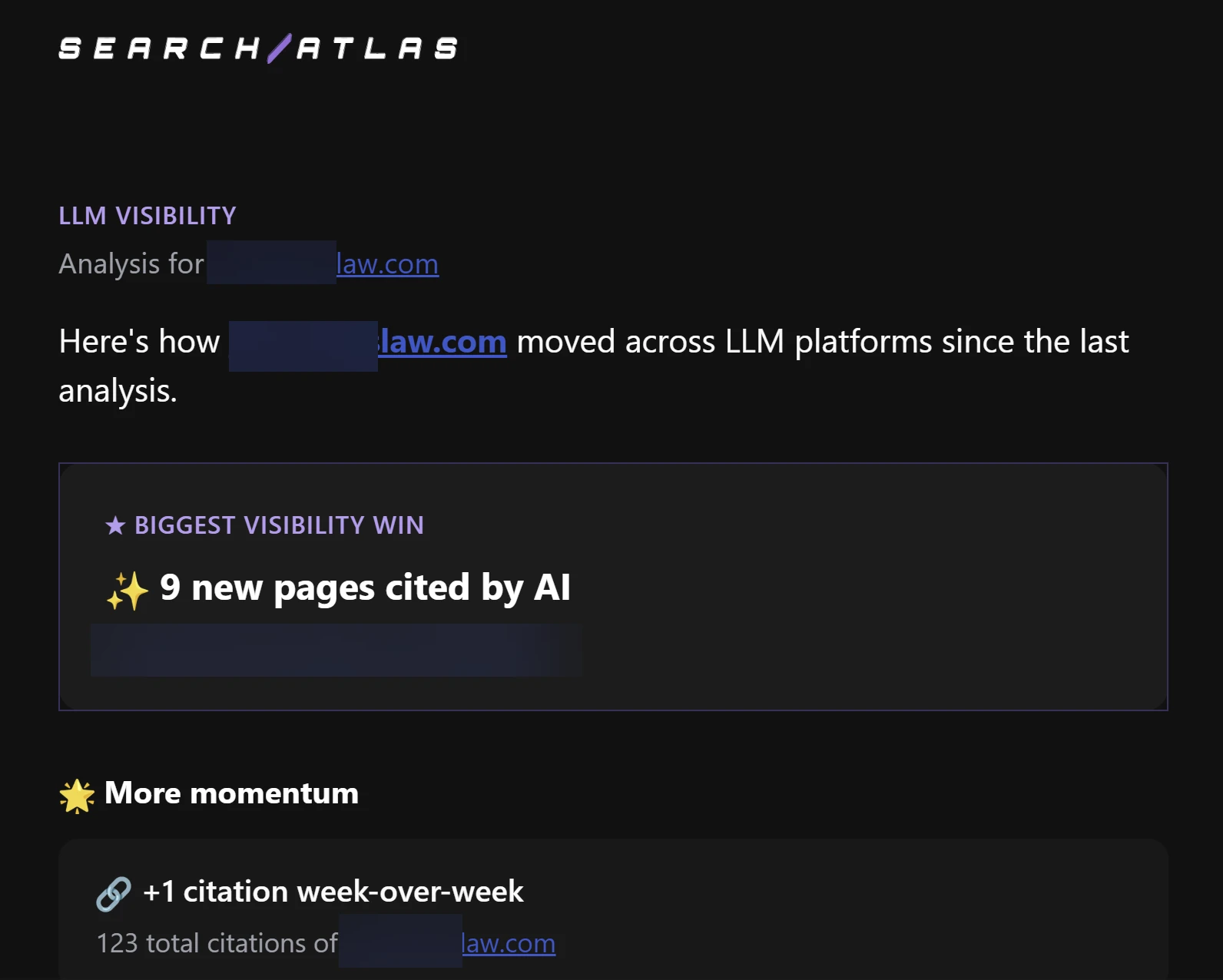
Neither curve is the product of one article. Both firms are on an ongoing program, which is the honest reading of these two screenshots: editorial signals are one input into a compounding system, not the whole system. The same pattern over a longer horizon shows up in our legal and law firm SEO work.
We Ran It On Ourselves, Then Published the Miss
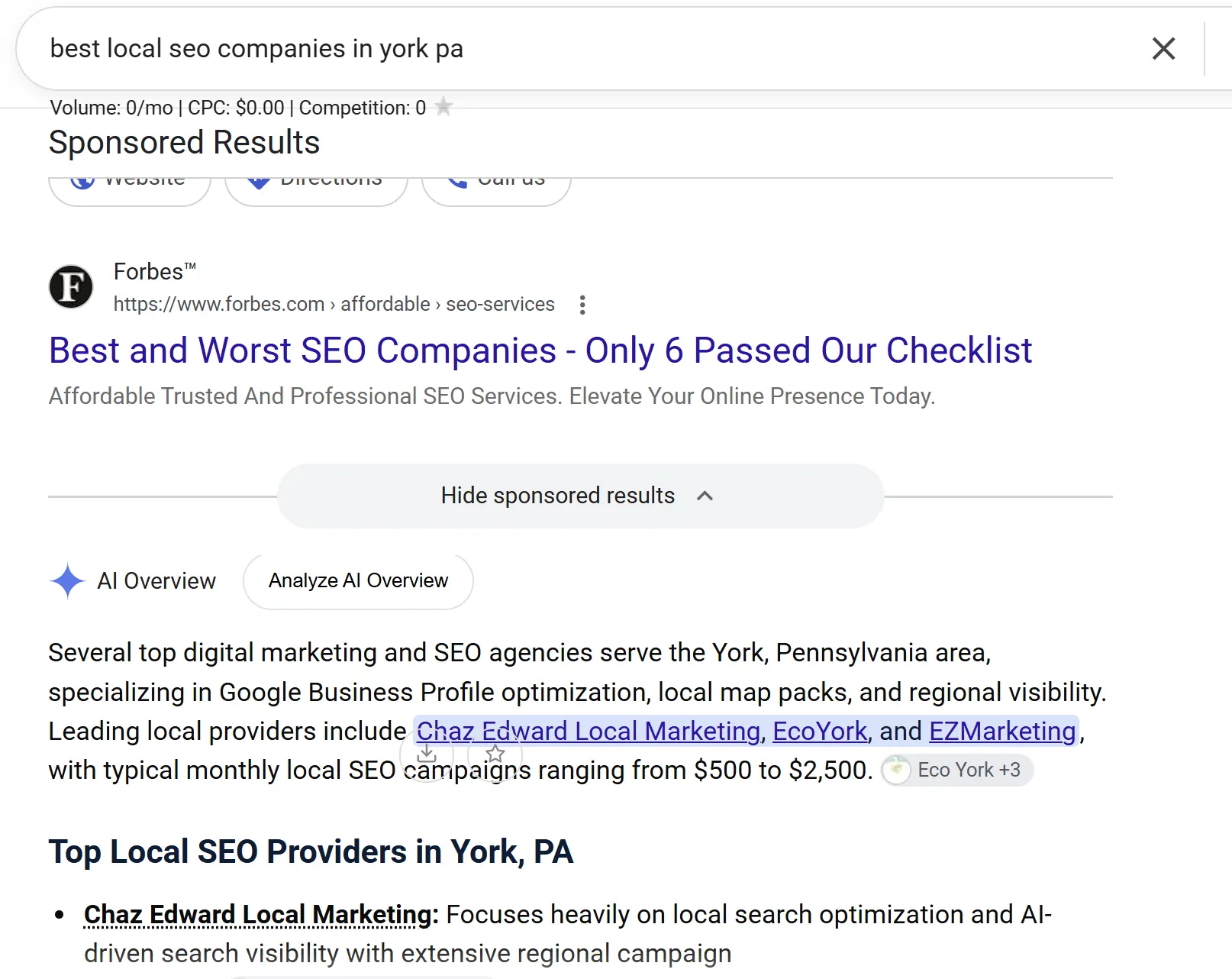
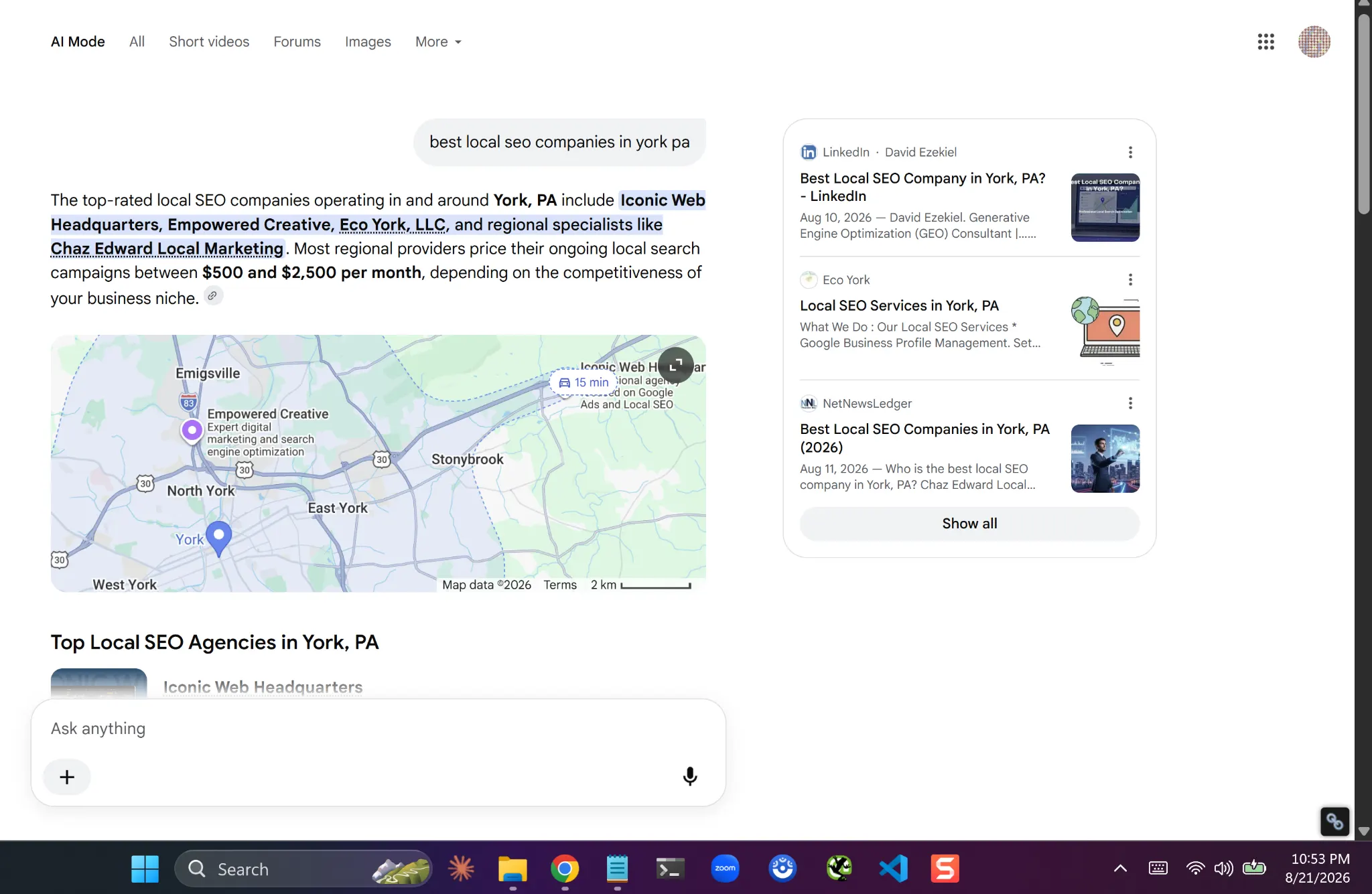
Testing a method on clients and never on yourself is a soft way to avoid an inconvenient result. In August 2026 we checked where Chaz Edward Local Marketing surfaces when someone asks Google's AI about local SEO providers in our own market, York, Pennsylvania.
For “best local seo companies in york pa,” the AI Overview named us directly among the leading local providers and described our focus on local search and AI-driven visibility. The same query in AI Mode also named us, listed as a regional specialist alongside three other York agencies.
Then we changed one word. Searching “best local seo agency york pa” instead of “companies” returned an AI Overview that named three other providers and left us out entirely.
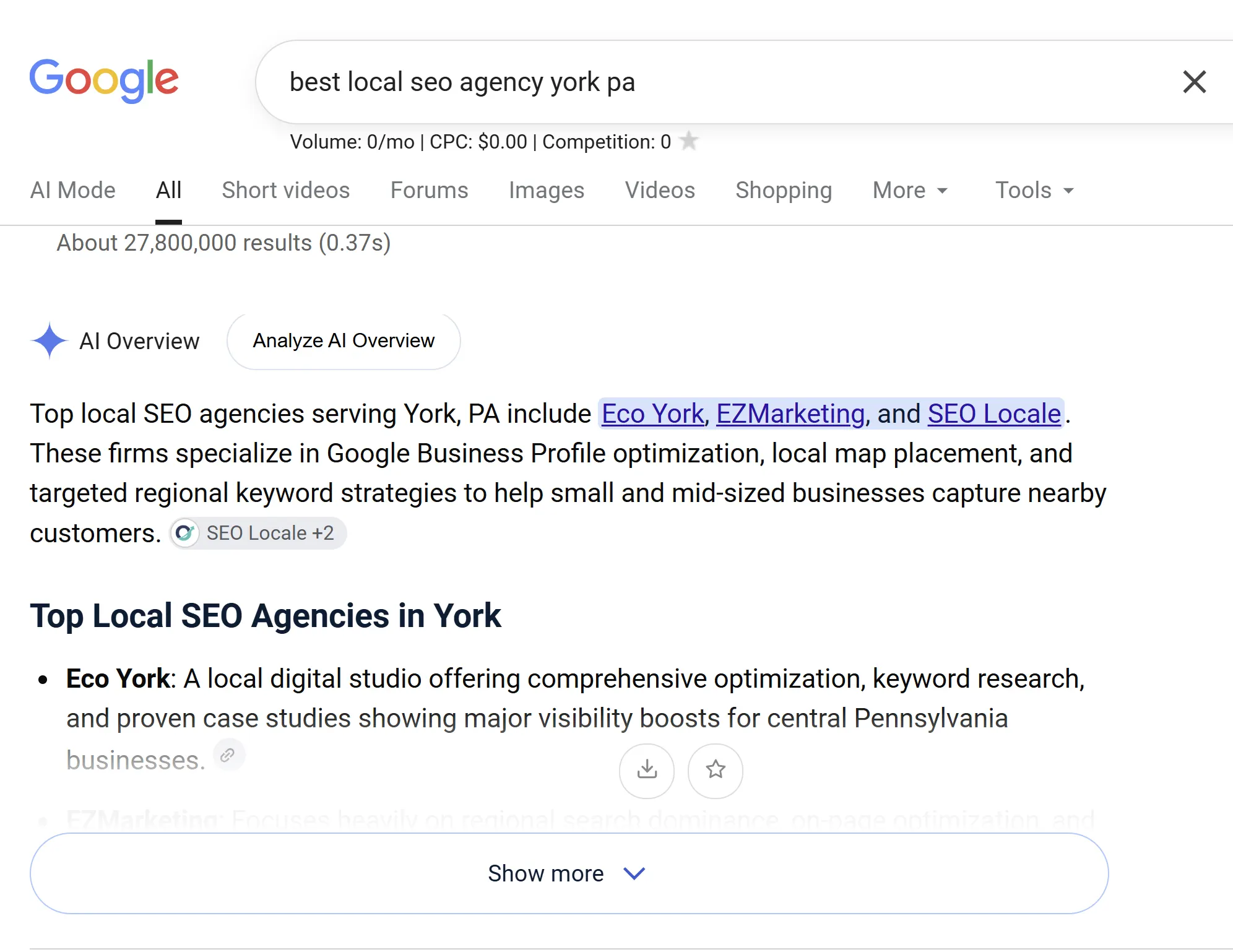
We are publishing that because the alternative is a case study that quietly implies a guarantee nobody can make. Query phrasing shifts which sources a model reaches for, and a single placement does not blanket every variant of a question. What an accumulating editorial footprint does is improve the odds across the phrasings that matter, which is why we sell this as an ongoing practice rather than a one-off fix.
What This Establishes, and What It Does Not
Four trials and two tracked accounts is a useful sample, not a controlled study. Here is the line we draw between the two.
Supported by this data
- A top-of-list editorial placement can move a business into the AI answer for its target query, in every one of the four trials run.
- The effect appeared quickly, between 6 and 16 days from the placement going live.
- It held across unrelated categories: dentistry, HVAC, and kitchen remodeling, in three different states.
- Structured comparison tables get rebuilt inside the answer panel, not merely cited beneath it.
- On accounts running an ongoing program, cited pages and total citations continued rising week over week.
Not established here
- That a placement wins every phrasing of a query. Our own brand test shows it does not.
- That the placement alone caused each move. Other campaign work was live on these accounts at the same time.
- Any revenue or lead-volume figure. This study measures AI answer presence only.
- How long a position holds. The tracking windows here run days and weeks, not quarters.
- That results transfer to national or non-local queries. Every trial was a local intent search.
Why the mechanism works at all
The direction of these results lines up with independent analysis of where AI systems actually source their answers. A study of citation patterns across Google AI Mode, ChatGPT, and Perplexity found brand-owned pages made up a small minority of cited sources, even in cases where the system recommended that brand by name, with most citation weight going to third-party sites (Search Engine Journal, 2026).
That is the gap a link on its own was never going to close. A backlink adds authority to your site. An editorial placement adds your name to the third-party comparison content the model is reading in the first place.
The distinction worth keeping: being linked to is not the same as being named. Across these four trials the businesses did not just acquire a citation. They became part of the sentence the AI wrote back to the searcher.
Running This for a Book of Clients?
Every format used in these trials is available at reseller pricing, with white-label reporting and one dashboard to order and track placements across accounts.
Access the Agency ShopWhat to Do With This
- Target the query, not the category: each trial moved the exact phrasing its placement was built around. Decide which question you need to win before buying anything.
- Format is leverage: comparison tables and explicit criteria got pulled into the answer panel directly. Prose-only coverage does not do that.
- Speed is the unusual part: 6 to 16 days is fast against any other off-site signal, which makes this a reasonable first move in a market where you currently have no editorial footprint.
- Coverage beats a single placement: our own brand appears for one phrasing and not a near-identical one. Breadth across query variants is what closes that gap.
- Pair it with the on-site work: the compounding curves came from accounts running placements alongside schema, answer-first content, and an optimized profile, not placements alone.
Be the Name the Answer Uses
City Best-Of, Local Listicle, or Top 3 Comparison. Live in three weeks, top-of-list position, guaranteed live for twelve months.
See Editorial Placement Pricing Talk to Us