
An AI Intake Assistant Converted 18% of Law Firm Chats Into Qualified Leads
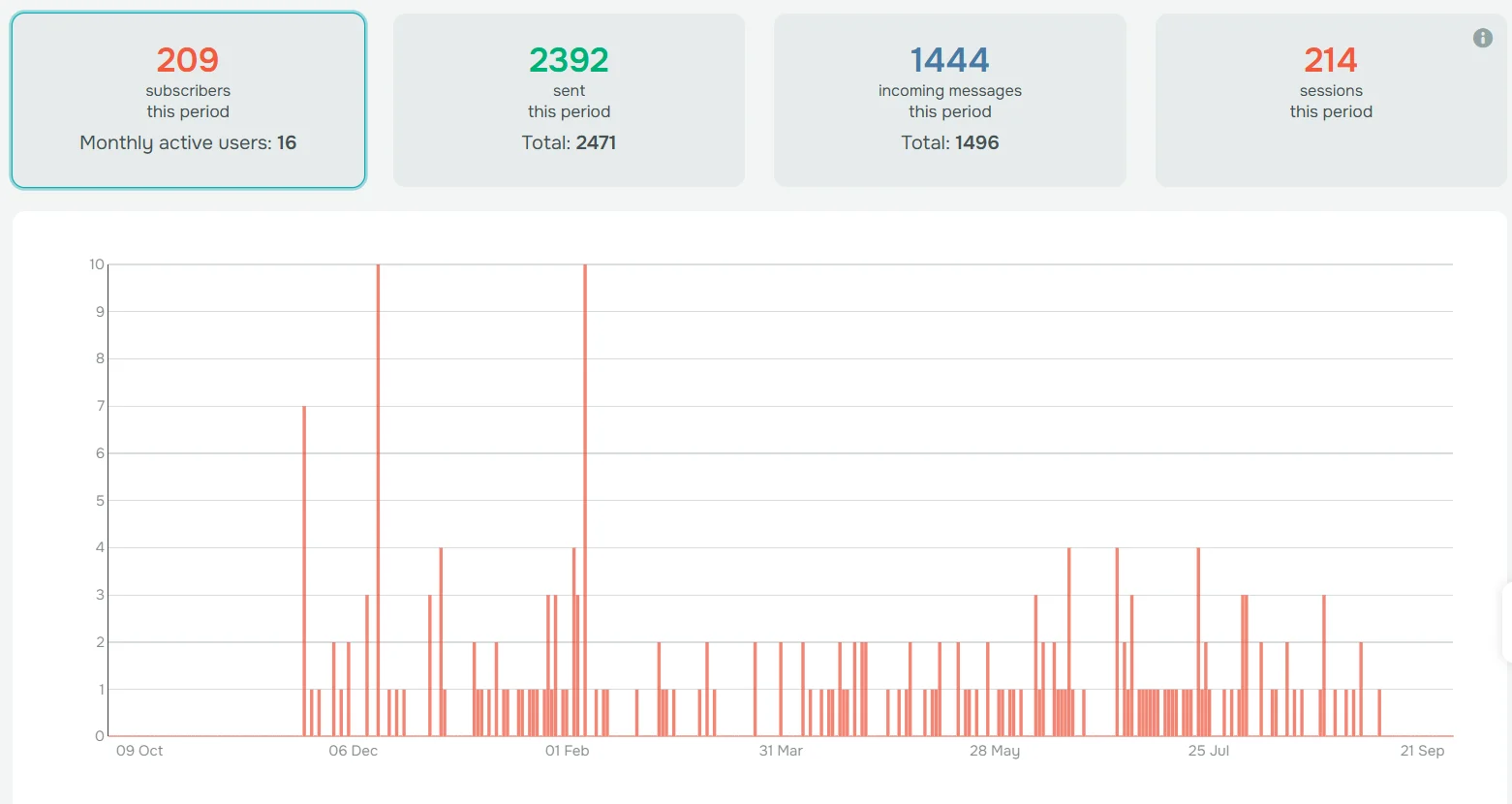
For a personal injury firm, we built a bilingual AI chatbot that handles intake around the clock. In its first year it held 209 conversations, captured 37 qualified and consented leads, and fed the pipeline that produced 36 signed cases. Industry benchmarks put typical website conversion at 2 to 4%. This system ran at 18%.
What a missed conversation costs a law firm
A personal injury lead who hits a dead contact form after hours does one thing: calls the next firm on Google. The case, the retainer, and every dollar of recovered damages go with them.
Most law firm websites still run on a plain contact form or a phone number. Neither one triages what comes in, neither sets expectations about the attorney-client relationship, and neither works at 11pm on a Saturday when the visitor just left the ER. We cover this gap in more depth in our guide on turning missed calls into revenue with chatbot and live chat setup.
The firm wanted a system that would hold that first conversation at any hour, in English or Spanish, and hand off an organized intake record the legal team could act on.
The numbers, from the platform itself
Every figure below comes straight from the SendPulse dashboard for this bot, covering its first year of operation from August 2025 through September 2026.
18% of conversations became qualified leads
The denominator is conversations (visitors who sent at least one message to the assistant), not raw page views. The numerator is leads who provided their name, phone number, and consent to follow up by text.
Where the benchmark comes from. Lucky Orange's 2025 benchmark report puts most websites at 1 to 4% conversion. Firstpagesage's 2024 industry data puts legal services at 3.8%. Against either range, 17.7% is about 4 to 9 times the benchmark. We are comparing conversations (visitors who engaged the chat) to qualified leads, not total site traffic to form fills, so the denominator is narrower and the comparison should be read that way.
That ratio is why we build AI intake into every law firm chatbot project instead of routing visitors to a static form. A structured conversation converts more of the visitors who are already on the site.
36 signed cases during the window this system was running
The firm closed 36 cases over the period this assistant was capturing and organizing intake. A single signed personal injury case can carry a recovery that dwarfs the cost of the entire system many times over.
We are not attributing a dollar figure or claiming per-lead ROI. What we can say is that 37 organized, consented intake records reached the legal team through this assistant, and 36 cases closed during the same period. The firm draws a direct line between the two.
A structured intake flow, not a single script
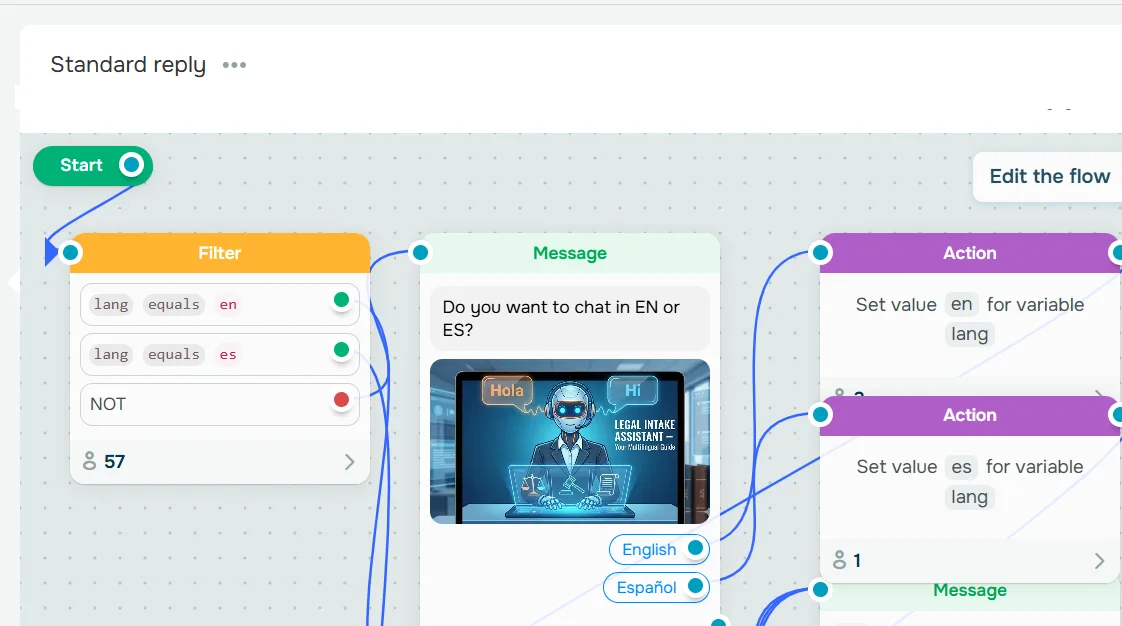
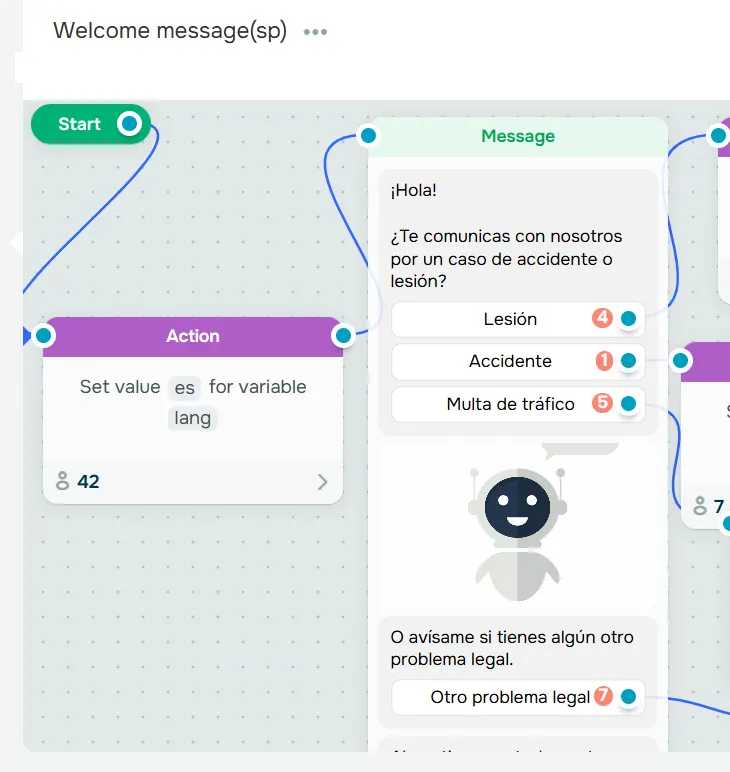
The assistant runs as a set of connected flows inside SendPulse's automation builder. A filter step reads the visitor's language, a menu narrows the case type, and a shared contact capture flow closes every conversation the same way.
Bilingual from the first message
A filter checks the visitor's stated language and branches into English or Spanish before any case-type content loads. The Spanish flow is not a translation layer; it runs its own welcome message and its own triage menu. This is the same pattern we use across our AI assistant chatbot builds for multilingual businesses.
One shared finish line
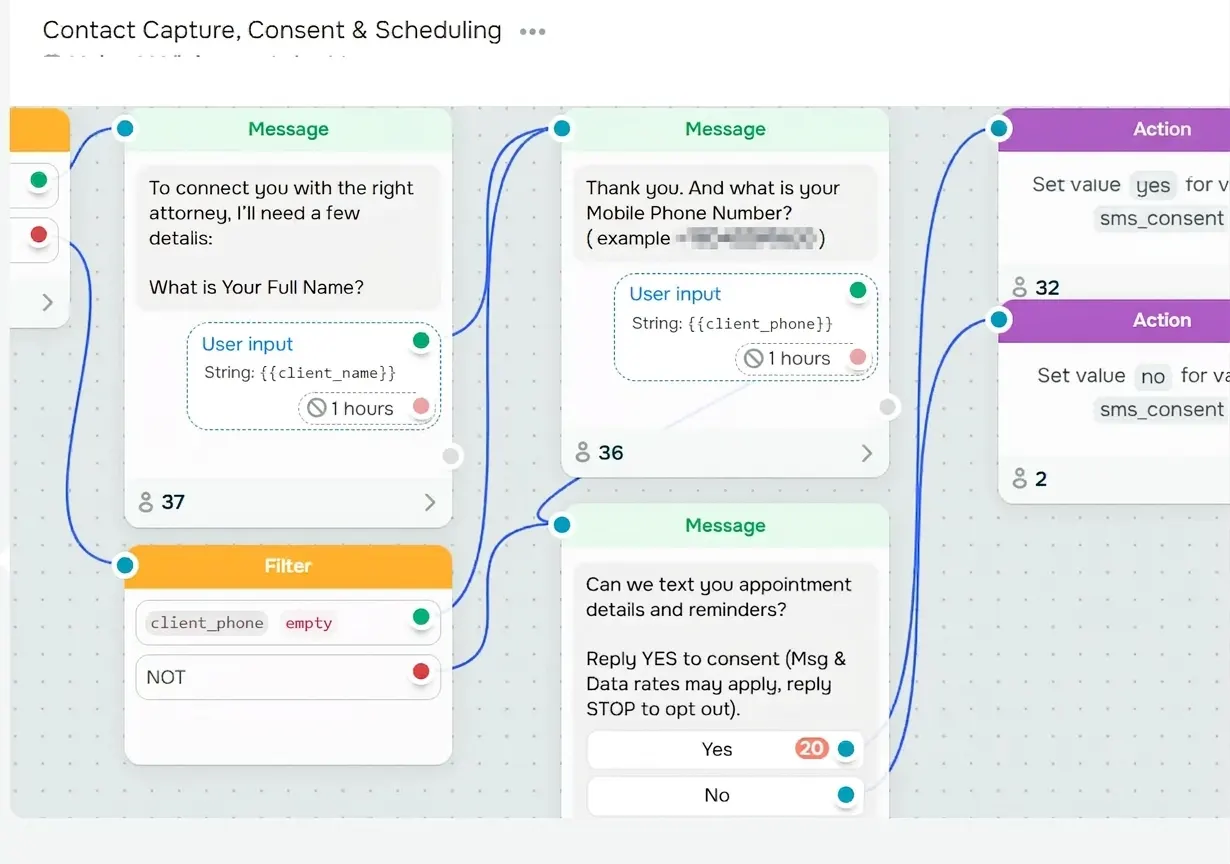
Every case type, injury, accident, or traffic ticket, funnels into a single contact capture flow: name, phone number, consent to text. That is the step that produces the 37 qualified leads reported in this case study.
The disclaimer runs before the first question
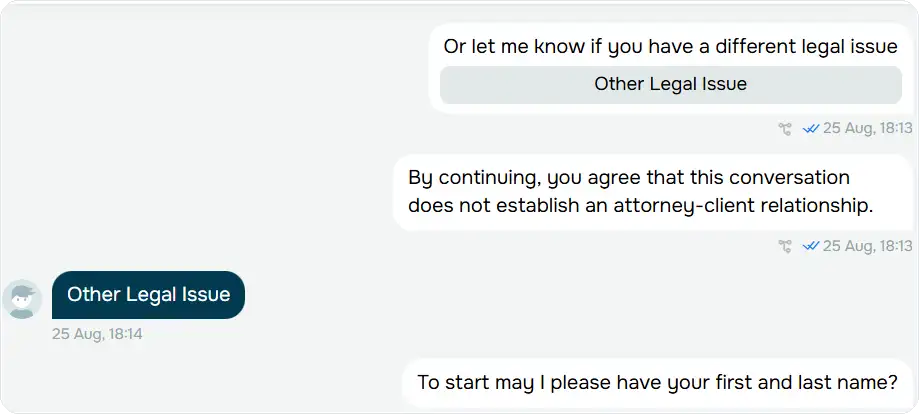
Before the assistant asks for a name or a single detail, it states in plain terms that the chat does not create an attorney-client relationship. The ABA's Formal Opinion 512 (2024) lays out how existing duties of competence, confidentiality, and communication apply once a firm brings AI tools into its practice. Model Rule 1.18 already covers what a firm owes a prospective client from the first conversation. That is why the disclaimer runs first, not after.
1,444 questions answered at zero marginal staff time
The assistant held 209 first conversations and fielded 1,444 incoming messages. It ran at 2am on a Sunday the same way it ran at 2pm on a Tuesday. If intake staff spent even a few minutes per inquiry, that volume represents dozens of hours the firm did not spend, while never missing a nights-and-weekends visitor.
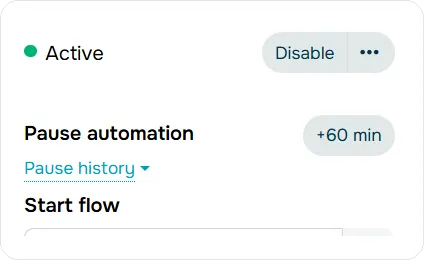
Every conversation carries controls that staff can use from the same screen: pause the automation for an hour, review the pause history, or restart a specific flow. The assistant handles the structured first response; a human can step in at any point. This is the same approach we build into every chatbot and live chat setup.
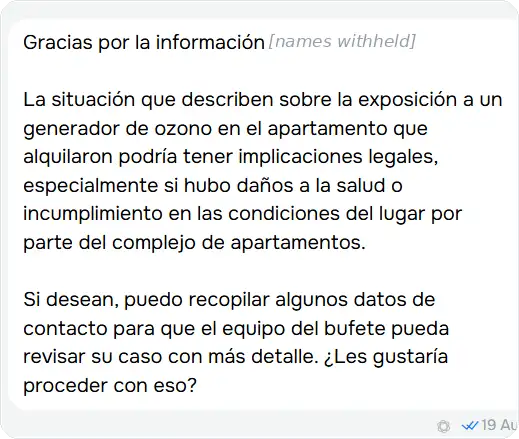
What the assistant says to visitors
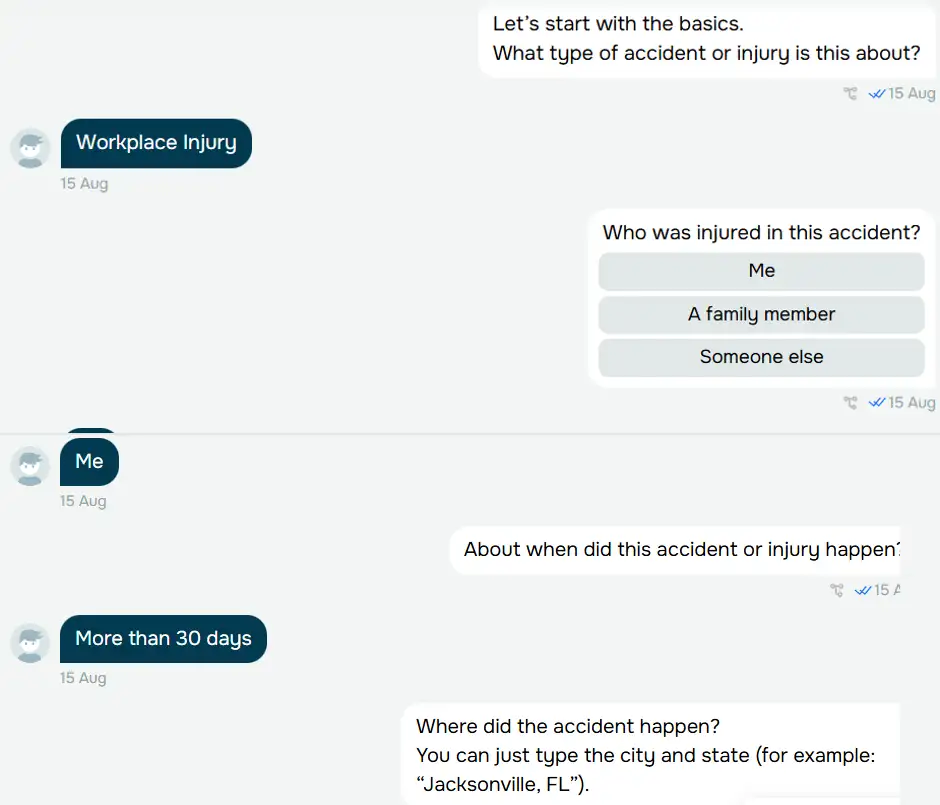
Unedited exchanges from the live chat platform. Names, the firm's domain, and other identifying details are removed.
89% of visitors who reached the final step finished it
The 89% figure measures something narrower than the headline conversion rate. It is the completion rate of the last step in the contact capture flow: of the 36 conversations that reached the phone-number question, 32 replied yes to text consent and 2 replied no. 32 divided by 36 equals 88.9%.
This is an internal quality metric. It means the flow's final step has low friction, that once a visitor is deep enough to be asked for a phone number, almost 9 in 10 finish. It does not measure how many visitors become leads (that is the 17.7% above) or how many leads become cases (that is the 36).
Why this number matters to an operator, not a prospect. A high completion rate at the final step means the contact capture flow is tight. If it ever dropped, that would signal a design problem in the last question, not a change in traffic quality. It is the metric we watch to keep the plumbing clean.
What this case study shows
- 18% conversation-to-lead conversion, about 4 to 9 times the industry benchmark: 37 qualified, consented leads from 209 conversations, against a legal-services average of 3.8%.
- 36 signed cases during the same window: the firm draws a direct line between the assistant's intake pipeline and the cases it closed.
- 1,444 questions answered at zero marginal staff time: the system covered nights, weekends, and every other hour the firm was not staffing phones.
- Bilingual from the first message: English and Spanish intake run as parallel flows, not a translation add-on.
- Disclaimer first, always: every visitor hears the attorney-client statement before being asked for a single detail.
Want a system like this for your firm?
We build AI chat assistants for law firms and other local service businesses that need a real first response, not just a contact form.
Not a law firm? The same approach runs through our general AI assistant chatbots service. If you also need more visitors finding the site, our legal and law firm SEO services cover that side of it. More client work is in our case studies.
