

White label SEO is one service resold by many agencies.

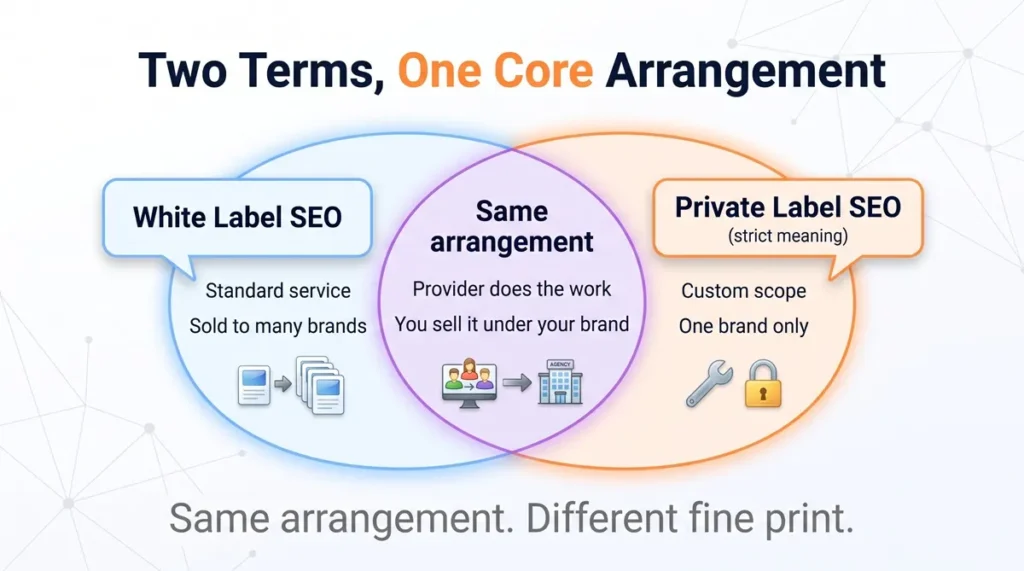
White label SEO and private label SEO describe the same arrangement in most SEO conversations: a provider does the work, and you sell it to your client under your own brand. The two terms come from retail, where they describe different kinds of products, and some providers still use them that way.
This guide is for agency owners, freelancers, and marketing leads who have seen both terms and want to know whether they are comparing two different services. It explains where the terms overlap, where they differ, and what to ask a provider before you sign.
White label SEO and private label SEO usually mean the same thing: a provider does the SEO work and you sell it under your own brand. Strictly, white label is a standard service sold to many brands, and private label is built for one brand, which typically costs more and starts slower. Most agencies and freelancers should choose white label, and confirm exclusivity, customization, and branding in writing with any provider.
- In practice, the terms overlap. In SEO, white label and private label usually describe the same arrangement: a provider does the work and you sell it under your own brand.
- In retail, they differ. A white label product is made once and sold by many brands. A private label product is made for one brand and sold only under that brand’s name.
- Where providers draw that line, private label SEO means a custom scope or exclusivity. It typically costs more and takes longer to start than a standard white label service.
- Ask for specifics, not labels. Confirm exclusivity, customization, branding on reports, response times, and contract terms in writing.
- Most agencies and freelancers need white label. It starts faster, costs less, and covers the same SEO service lines.
- CELM delivers white label SEO with a 2-business-day campaign start SLA and your logo on every report and deliverable.
What Is White Label SEO?
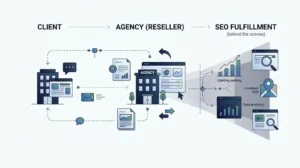
White label SEO is an arrangement where an SEO provider performs the work and a reseller sells it under the reseller’s own brand. The reseller can be an agency, a freelancer, or a consultant. You own the client relationship, the branding, and the invoice. The provider owns the execution: keyword research, on-page work, content, link building, local SEO, and reporting.
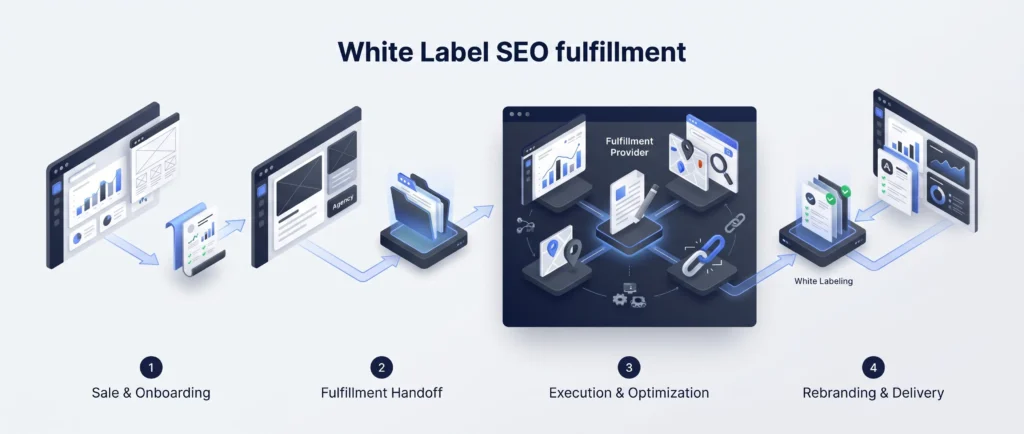
A white label engagement usually runs in four steps:
- You sell an SEO service to your client at your own price.
- You order the matching campaign from the provider.
- The provider does the work and reports on it under your brand.
- You review the results and deliver them to your client.
Your client sees your name on every report and dashboard. Chaz Edward Local Marketing starts each campaign within a 2-business-day SLA, and every deliverable carries your logo. The white label SEO services page explains how CELM’s fulfillment works, from kickoff call to monthly reporting. For a step-by-step view of reselling, read what white label SEO is.
What Is Private Label SEO?
Private label SEO has two meanings: a loose one that matches white label SEO, and a strict one that comes from retail.
The loose meaning. Many providers use “private label SEO” as a synonym for white label SEO. The provider does the work, and you present it to your client as your own service. If a provider uses the term this way, you are looking at the same arrangement described above.
The strict meaning. In retail, a white label product is made once and sold by many brands, each adding its own label. A private label product is made for one brand and sold only under that brand’s name. The Consumer Product Safety Act reflects the second idea: it says a consumer product bears a private label when it carries a brand other than the manufacturer’s and no manufacturer brand appears on the label. That definition covers physical products, but the idea carries over to services. Applied to SEO, private label means a provider builds a service package for a single agency, with custom scope, custom deliverables, and sometimes exclusivity.
Because SEO is labor and not a manufactured product, the difference shows up in contract terms: what you can customize, and whether the provider can sell the same service to other agencies in your market. Providers that draw this line typically price private label higher and take longer to start, because the service is built around one brand. Costs and timelines vary by provider, so confirm both before you commit.
White Label vs. Private Label SEO: Side-by-Side Comparison
The two models share the same core arrangement and differ in customization, exclusivity, cost, and start time. The table uses the strict retail meaning of private label. In everyday SEO conversation, many providers use “private label SEO” to mean the first column.
Factor | White label SEO | Private label SEO (strict meaning) |
Core arrangement | The provider does the work and you sell it under your brand. | The same arrangement. |
Who else buys it | Many agencies buy the same standard service lines. | One agency, when the provider applies the term strictly. |
Customization | Standard service lines with your branding on reports and dashboards. | Scope, deliverables, and report formats built around your brand. |
Cost | Lower, because the provider spreads setup and tooling across many resellers. | Higher, because custom work and exclusivity cost more. |
Time to start | Days. CELM starts campaigns within a 2-business-day SLA. | Longer, because scoping and setup come first. |
Best fit | Agencies, freelancers, and consultants who want to start selling SEO quickly. | Established agencies with specific requirements and the budget to fund them. |
Costs and timelines vary by provider. The most reliable way to compare is to ask each provider for its scope, branding terms, and price in writing.
What Both Models Can Include
Both models can cover the same SEO service lines, because the label describes the arrangement and not the work. These are the services agencies resell most, with the CELM page for each:
- Local SEO: map-pack ranking campaigns built on citations, localized pages, and a steady local signal cadence, through white label local SEO.
- Google Business Profile: setup, categories, services, posts, and Q&A, through white label GBP management.
- Link building: guest posts, editorial placements, and niche edits, through white label link building.
- Content and editorial coverage: news coverage and feature articles under your agency’s name, delivered as press and media placements.
- Web design: city and service page silos or full site builds, through white label SEO web design.
- AI search: answer-first content and schema for ChatGPT, Gemini, and Google AI Overviews, through white label AI SEO.
- Reporting: geogrid, ranking, and completed-work reports with your logo.
You can resell these as standalone services or as bundles. What changes between white label and private label is how much of the scope the provider will custom-build for you.
How to Tell What a Provider Means
Ignore the label and ask what the provider will do, because providers use both terms loosely. Put these six questions to every provider and get the answers in writing:
- Is the service standard, or built for my agency? A standard service is white label. A service built around your brand is private label in the strict sense.
- Do you sell the same service to other agencies in my market? This is the exclusivity question. A “yes” means the service is not exclusive, whatever the provider calls it.
- Does every report, dashboard, and deliverable carry my logo? Also ask whether the provider ever names itself to your clients.
- What can I change in scope, deliverables, and reporting, and what costs extra? Ask for a sample invoice for a typical client.
- How fast does a campaign start, and who answers my questions? CELM starts campaigns within a 2-business-day SLA, with SMS responses within one hour and email responses within 24 hours.
- What do the contract terms say about minimum commitments and ending the agreement? Look for a short pilot or month-to-month term before any long minimum.
Start with one client for 60 to 90 days, then review deliverables, communication, and results before you send more accounts. If the provider builds links, ask where the links are placed and how, then compare the answers with Google’s spam policies, which treat links meant to manipulate rankings as link spam. For typical price ranges and the extra fees to look for, see our guide to white label SEO pricing.
Which Fits Your Business
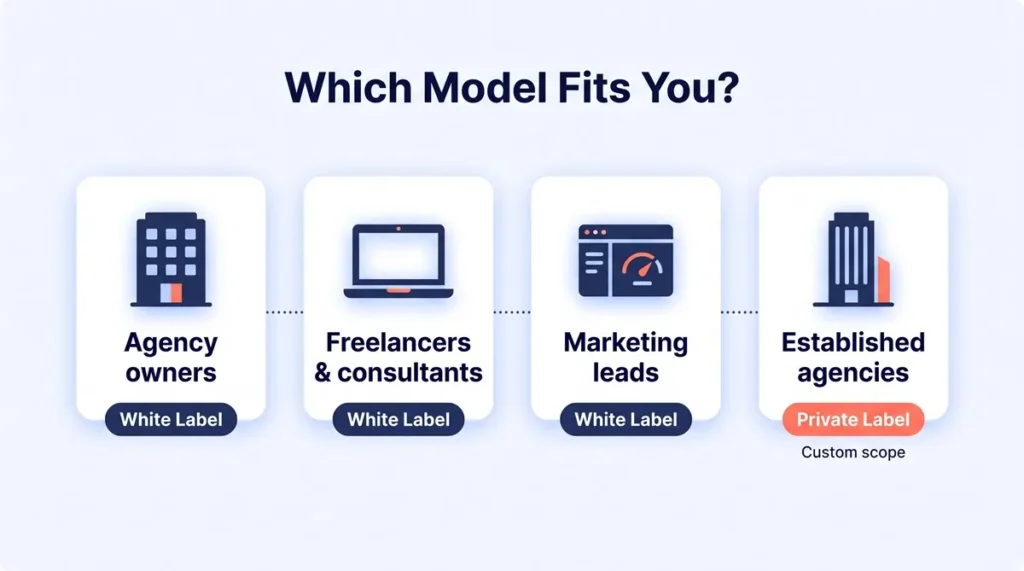
Most agencies, freelancers, and consultants need white label SEO, and private label in the strict sense fits a narrow group. Match your situation below:
- Agency owners adding SEO or covering overflow: Choose white label. It starts in days and adds no payroll. If you are still deciding whether to outsource at all, read our comparison of in-house vs. white label SEO.
- Freelancers and consultants: Choose white label. You get fulfillment, tools, and reporting without hiring or paying for a tool stack. CELM’s SEO reseller program covers plans, volume tiers, and onboarding.
- Marketing leads managing client accounts: Choose white label. Your team keeps strategy and client communication while the provider produces the work.
- Established agencies with specific requirements: Consider private label in the strict sense. It fits when you need a custom scope or market exclusivity and can fund higher costs and a longer setup. Get the exclusivity terms in writing.
If you are unsure, test white label on one client first. Once you have seen the quality of the work, you can ask the provider what it will customize.
Frequently Asked Questions
What is the difference between white label SEO and private label SEO?
In most SEO conversations, there is no difference: both mean a provider does the work and you sell it under your own brand. In the strict retail sense, white label is a standard service sold to many agencies, while private label is built for one agency only. Confirm which meaning a provider uses before you compare quotes.
Which is better, white label or private label SEO?
Neither is better by default. White label SEO starts faster, costs less, and covers the same service lines, so it fits most agencies, freelancers, and consultants. Private label, in the strict sense, fits agencies that need a custom scope or market exclusivity and can pay more and wait longer.
How much does white label SEO cost?
White label SEO typically costs $500 to $1,500 per month per location for local SEO, and $1,500 to $3,500 per month for packages that add content and links. Prices vary by provider, scope, and market. Private label arrangements typically cost more because the work is built around one agency. See our white label SEO pricing guide for the full breakdown.
Is white labeling illegal?
No. White labeling is a legal, common business arrangement, and white label SEO is not inherently deceptive. The legal details sit in your contract: scope, confidentiality, who may contact your clients, and who owns the deliverables. Have a lawyer review any agreement before you sign. This is general information, not legal advice.
What are the disadvantages of white label SEO?
The main disadvantages are less direct control over execution, dependence on the provider’s quality and availability, and limited customization of standard services. If the provider misses a deadline, your client still holds you responsible. Reduce the risk with a 60 to 90 day pilot on one client, written deliverables, and a sample report.
Can you make money with white label SEO?
Yes. Most agencies mark white label SEO up 50% to 100% over the provider’s price. For example, a $1,000 monthly fulfillment cost sold at a 50% to 100% markup gives a client price of $1,500 to $2,000 and a gross margin of $500 to $1,000 before your own time and overhead.
Start With White Label SEO
If you want SEO fulfillment under your own brand, CELM runs it for agencies, freelancers, and consultants. We have managed 10,000+ campaigns since 2015 and work with 194 agency partners, and every report and deliverable carries your logo.
Review our white label SEO services to see what you can resell. Plans and pricing are published in the Agency Shop, and you can book a discovery call to scope your first campaign.