

In-House vs White Label SEO: How Agencies Sell SEO Without Hiring a Team
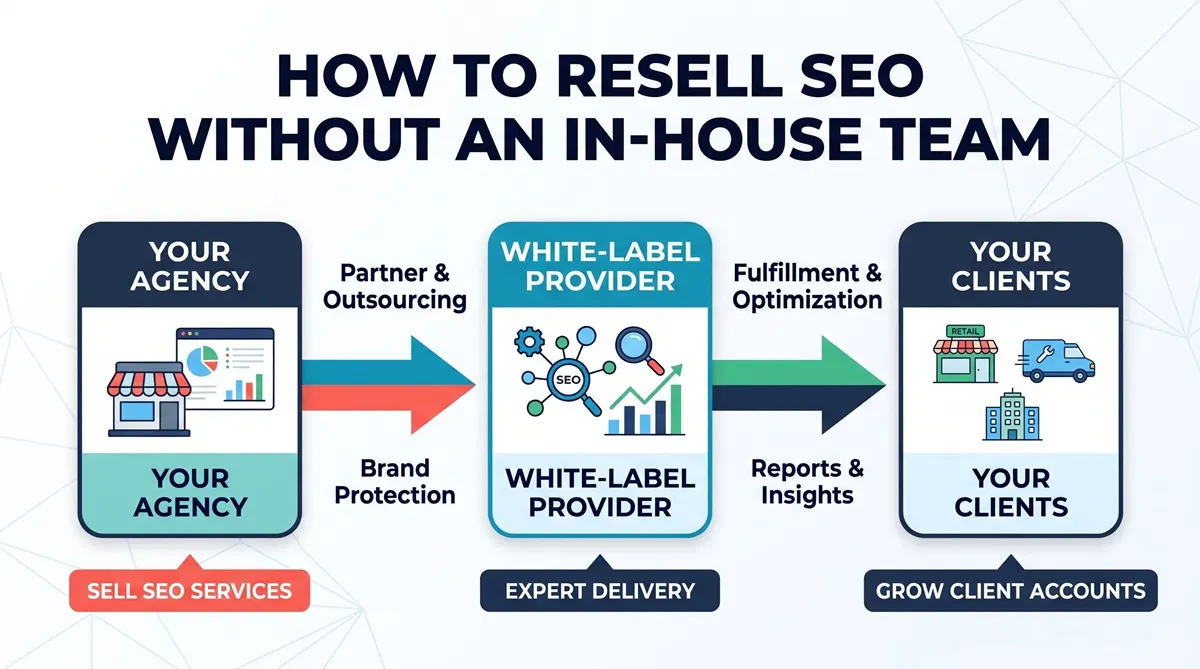
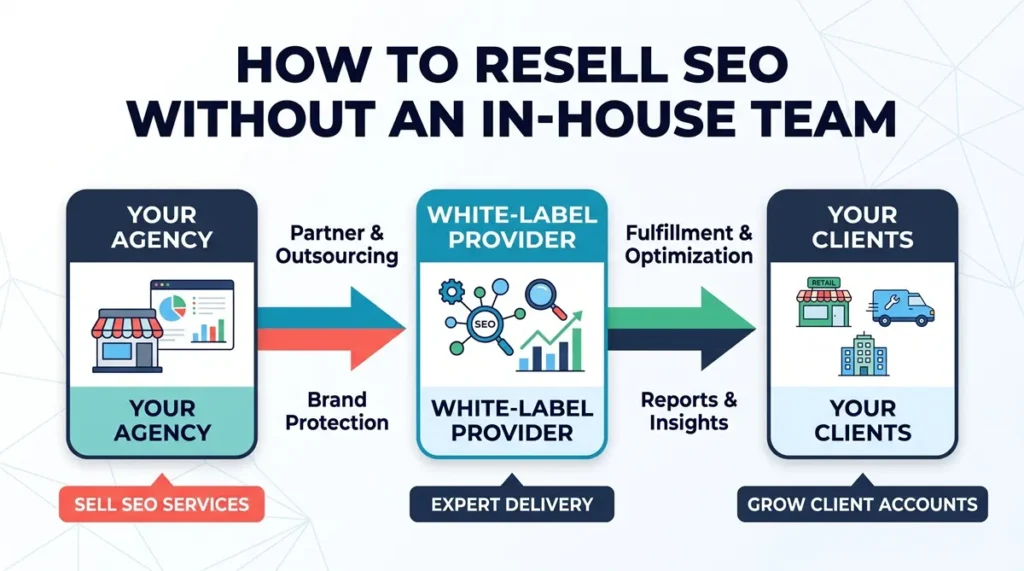
You can resell SEO without an in-house team by contracting a provider that performs the work under your brand. Your agency keeps the client relationship, sets the retail price, and keeps the margin. The provider handles keyword research, on-page work, content, links, and reporting. This model is called white label SEO, and it is the main alternative agencies weigh when they compare in-house vs white label SEO.
You can resell SEO without hiring by contracting a provider that performs the work under your brand, so you keep the client, the price, and the margin. In-house fits agencies where SEO is the core product and client volume keeps specialists billable every week. White label fits agencies with early or uneven demand, because you pay per active campaign instead of full-time salaries. To start, pick one or two service lines, vet the provider on branding, start time, response time, and link standards, set your retail price, onboard one client, and report monthly.
In-house vs white label SEO: the short answer
Hire in-house when SEO is your core product and you have enough client volume to keep specialists billable every week. Use white label fulfillment when SEO is one service among several, when demand is uneven, or when you want to sell SEO before you hire for it.
The difference comes down to five factors. For row-by-row detail, see the full comparison.
Factor | In-house team | White label fulfillment |
Cost | Salary and benefits for each hire | One cost per active campaign; you set the retail price |
Tools | Rank tracker, crawler, backlink tool, and local SEO tool subscriptions | Included in fulfillment |
Ramp time | Months to recruit and onboard | Campaigns start within a 2-business-day SLA with CELM |
Flexibility | Hire to grow, lay off to shrink | Add or drop campaigns as your client list changes |
Utilization risk | You pay staff whether or not work exists | You pay per active campaign |
What an in-house SEO team requires before it produces anything
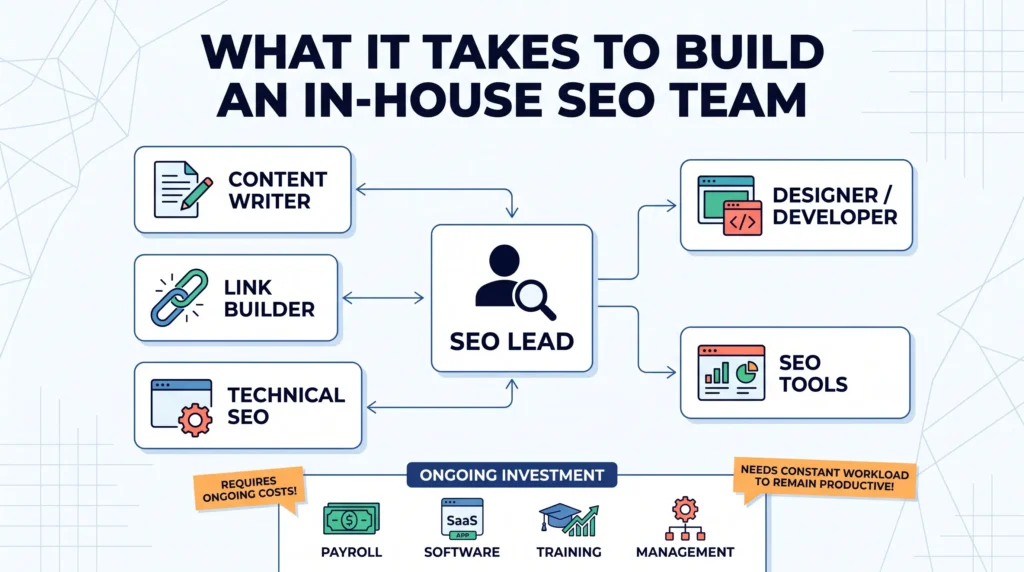
One SEO hire rarely covers the whole job. Local SEO, technical fixes, content, link acquisition, and client reporting are separate skills, and a client who pays for rankings expects all of them.
A realistic in-house setup needs:
- A local or technical SEO lead who audits sites, fixes crawl and schema issues, and manages Google Business Profiles.
- A writer who produces service pages, city pages, and blog posts that match search intent.
- A link builder who runs outreach for guest posts and niche edits. If you would rather not build that function, white label link building covers it.
- A designer or developer for the page changes SEO requires. When you have none on staff, white label SEO web design covers city and service page builds.
- Software: a rank tracker, a site crawler, a backlink tool, and a local rank tracker, each billed monthly.
Each role costs a full salary before the first campaign ships, and recruiting and training take months during which no client work gets done.
The larger risk is utilization. If you sign two SEO clients, you still pay the whole team.
When hiring in-house still makes sense
In-house SEO works in three situations:
- SEO is your primary product, and your pipeline keeps specialists busy every week.
- Your own proprietary process is the reason clients buy from you.
- You have the management capacity to recruit, train, and review the work.
If none of those apply, hiring before you have clients puts payroll ahead of revenue. Many agencies start with fulfillment, learn which service lines sell, then hire for the lines with steady volume.
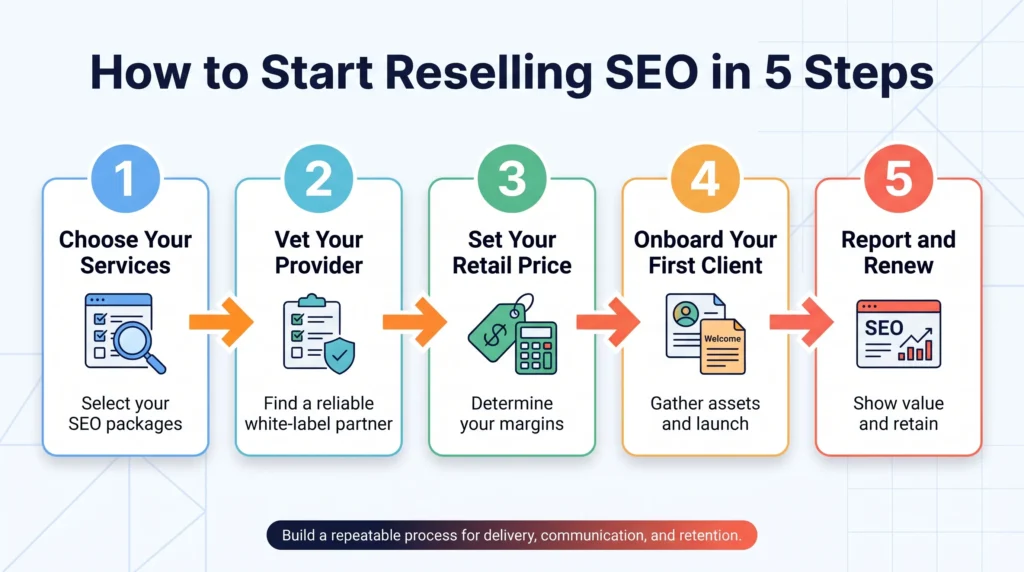
How to resell SEO without a team: five steps
- Pick the service lines you will sell. Start with one or two packaged offers, not a menu of ten. Local businesses buy Google Maps rankings, so white label local SEO and white label GBP management are common first products. Clients also ask how to show up in ChatGPT and Google AI Overviews, which white label AI SEO covers.
- Vet the provider on the points that affect your brand. Ask five questions. Do reports and dashboards carry your logo, and does the provider stay invisible to your clients? How many days pass between your order and the campaign start? How fast do they answer messages? Which link types do they build, and do they refuse PBNs? Is pricing published, or do you need a sales call to see it? For reference, CELM starts campaigns within 2 business days and answers texts within 1 hour and email within 24 hours.
- Set your retail price above the provider’s cost. Price each package before you pitch it, so you know your margin on the first sale. Make sure the margin pays for your sales and account management time, not only the invoice. Providers with volume tiers lower your cost as you add campaigns.
- Onboard the first client. Collect site access, Google Business Profile access, and the client’s goals. Hold a kickoff with the provider’s account manager. The provider audits the site and profile, maps the strategy, and starts work.
- Report and renew every month. Clients keep paying for SEO when they can see progress. Send monthly reports under your brand that show map rankings, keyword positions, and the work completed. White label client reports pull that data from geogrids and rank tracking under your logo.
Mistakes that cost resellers margin and clients
- Choosing the provider on price alone. Cheap fulfillment with thin content or low-quality links creates problems you explain to the client later. Ask what link types the provider builds and what domain-rating standards it holds.
- Skipping review of the first deliverables. Read the first reports, pages, and Google Business Profile changes yourself. You own the client relationship, so you answer for the work.
- Promising a specific rank. Rankings vary by market, competition, and site history. Sell the monthly work and the reporting, and set timeline expectations in writing.
- Reselling a service you cannot explain. You do not need to perform the work, but you do need to describe in plain language what happens each month.
- Switching providers every quarter. A new provider means a new onboarding and a pause in campaign momentum. Test one provider with one or two clients, then add more.
Frequently Asked Questions
What is the difference between in-house vs white label SEO?
In-house SEO means you hire and manage your own specialists and pay for their tools. White label SEO means a provider performs the work and you sell it under your brand, paying per active campaign.
Is white label SEO cheaper than hiring?
For most agencies with low or uneven SEO volume, yes, because you pay per active campaign instead of full-time salaries. At high, steady volume, run the numbers against your own payroll and tool costs.
Will my clients know a provider does the work?
Not under a true white label arrangement. Reports, dashboards, and deliverables carry your brand, and the provider stays behind the scenes.
How much margin can I earn reselling SEO?
Your margin is your retail price minus the provider’s cost per campaign, and you set the retail price. Price each package before you pitch it, and check that the margin also pays for your sales and account management time.
What should I look for in a white label SEO provider?
Look for branded reports and dashboards, a fast campaign start time, quick message response, published pricing, and link standards that exclude PBNs. Ask for the start time and response windows in writing.
Can I resell individual services, or only full packages?
Both are possible with CELM. You can resell a single service such as GBP management or link building, or bundle several into one package for the client.
Start reselling SEO without hiring
If you want to add SEO to your agency without adding headcount, review CELM’s white label SEO services and browse plans in the Agency Shop. To see how onboarding, account management, and reporting work for partners, read about the SEO reseller program.