



How reviews, citations, and press coverage work together as local ranking signals, and where to start if you haven't managed any of it yet.

Reputation management SEO is the practice of controlling what a search engine and an AI answer engine find when someone looks up your business name, then using that information as a ranking signal instead of an afterthought. It covers your Google reviews, your star rating, your citation consistency across directories, your press and media mentions, and the schema markup that tells search engines those signals are real.
It’s not the same as traditional public relations, and it’s not the same as review generation alone. Reputation management SEO treats trust signals as part of your local search strategy, not a separate department.
- Reputation management SEO is the intersection of brand trust signals (reviews, mentions, citations) and local search ranking factors.
- Google’s E-E-A-T framework (Experience, Expertise, Authoritativeness, Trustworthiness) uses reputation signals directly. A business with consistent five-star sentiment and clean citations outranks a comparable competitor with thin, inconsistent data.
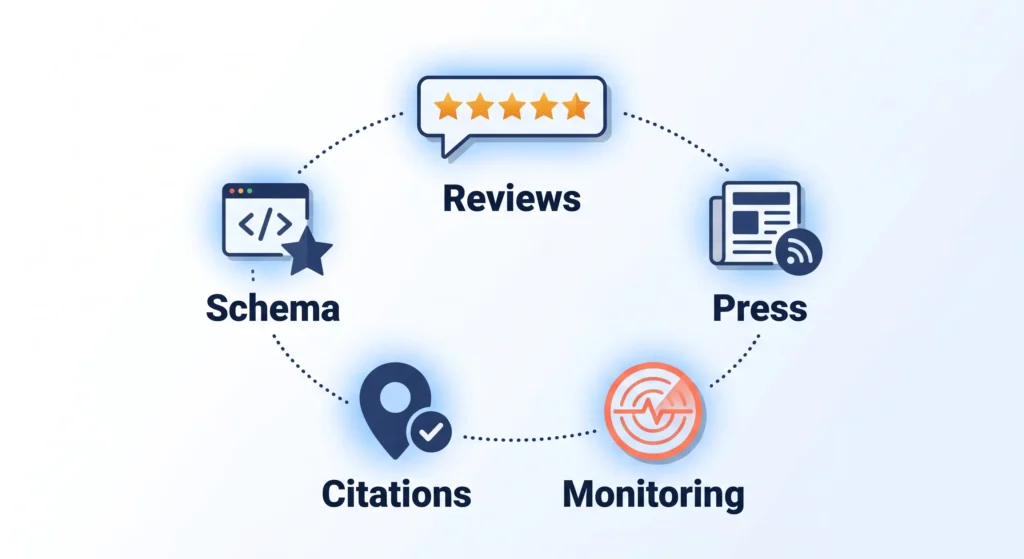
- The core components are review generation and response, review schema markup, NAP citation consistency, digital PR and press coverage, and monitoring for fake or malicious reviews.
- Reputation management is proactive (built before a problem exists). Crisis response, like removing a fake review or fighting an extortion attempt, is one piece of it, not the whole strategy.
- A press release that embeds your Google Business Profile does double duty: it earns a published citation and it reinforces the exact entity data local search and AI engines use to confirm who you are.
How Reputation Management Fits Into SEO
Search engines rank local businesses on more than keywords and backlinks. Google’s own quality guidelines describe E-E-A-T: Experience, Expertise, Authoritativeness, and Trustworthiness, alongside Prominence and Relevance for local results. Reputation signals feed directly into the “T” and the “P”: how trustworthy your business appears, and how prominent it is across the web.
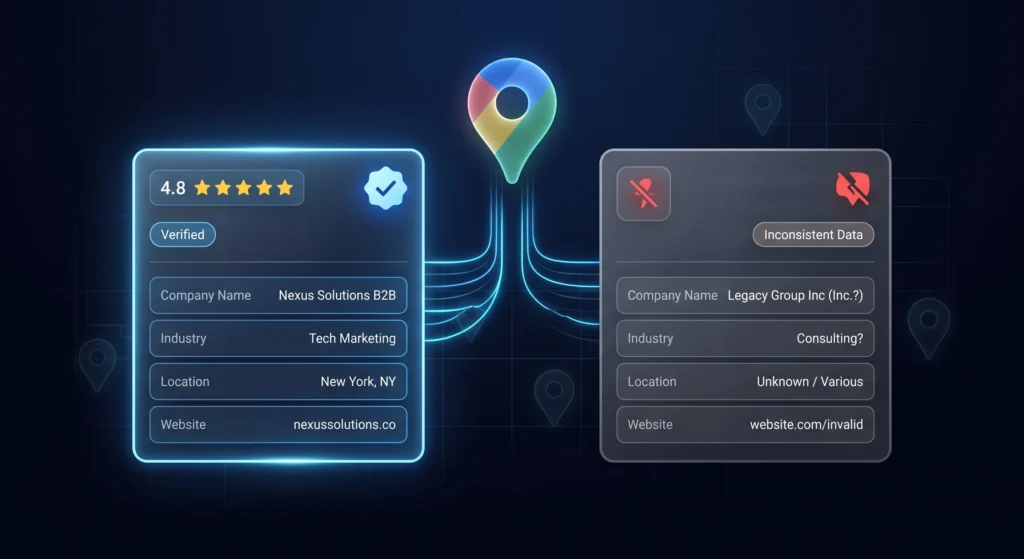
A business with a 4.8-star rating, 200+ reviews, consistent name-address-phone (NAP) data across directories, and a handful of press mentions sends a different signal than a business with a 3.2-star rating, 12 reviews, and mismatched addresses on three different listing sites. Google reads both profiles as data. One tells the algorithm this business is established and trusted. The other tells it there’s risk.
That’s the SEO half of reputation management. The reputation half is what a human sees when they search your business name directly: the reviews, the news coverage, and whatever else fills the first page. Reputation management SEO treats those as the same problem, because increasingly, they are.
The Core Components of Reputation Management SEO
Review Generation and Response
Reviews are the most direct trust signal you control. Volume, recency, and star rating all factor into local rankings, and response rate matters almost as much as the reviews themselves. A business that responds to reviews within 48 hours signals active management. A business with a wall of unanswered one-star reviews signals the opposite, to both customers and to Google.
An automated review generation system (SMS or email sequences triggered after a customer interaction) fills the top of the funnel. Response management fills the rest: replying to every review, positive or negative, in a voice that matches your brand.
Review Schema Markup
A five-star rating means nothing to a search engine unless it’s marked up so the engine can read it. Review schema and aggregate rating schema, covered in our local schema guide, turn your reviews into structured data, which is what produces the star-rating snippets you see under some search results. Structured reviews also give AI answer engines a verified data point to cite when someone asks an AI assistant to recommend a business like yours.
NAP Citation Consistency
Your business name, address, and phone number need to match, exactly, across your Google Business Profile, your website, and every directory that lists you. Inconsistent NAP data is one of the most common reasons a business plateaus in the map pack even after review counts climb. Citation audits catch mismatched suite numbers, old phone numbers, and duplicate listings before they cost you visibility, and a listings management service handles that correction work across every directory at once instead of one listing at a time.
Digital PR and Press Coverage
Press mentions are citations too, just from a different source. A published article on a news domain that references your business name, location, and category corroborates the same entity data your Google Business Profile and directory listings already carry. That corroboration is what search engines and AI models look for when deciding whether a business is real, established, and worth citing.
This is where press releases earn their place inside a reputation management SEO strategy instead of sitting off to the side as a separate marketing tactic. A release that embeds your Google Business Profile or a video, distributed to real outlets and picked up by Google News, creates an unstructured citation on an authoritative domain. See our local press release service for how that distribution works, or read more on how press coverage rolls into a full reputation and brand management strategy.
Monitoring and Response to Fake or Malicious Reviews
Not every negative review is a legitimate complaint. Review extortion, where bad actors post fake one-star reviews and then offer removal for a fee, is a documented and growing threat, serious enough that the FTC’s rule on fake and paid reviews now lets the agency pursue civil penalties against any business, or any reputation firm, that creates, buys, or sells them. Reputation management SEO includes ongoing monitoring, often through managed reputation monitoring, so a coordinated attack gets caught and reported within hours, not discovered a week later when the damage is already sitting on your profile.
How Reputation Signals Affect Local Rankings
Local ranking factors break down into three general buckets: relevance, distance, and prominence. Reputation signals sit almost entirely inside prominence, and prominence is the bucket most businesses ignore because it isn’t a one-time fix.
A few of the specific signals at play:
- Review count and velocity. A steady stream of new reviews signals an active, operating business. A stalled review count signals the opposite, even if the historical rating is strong.
- Star rating relative to competitors. Rankings are relative. A 4.5-star business can outrank a 4.8-star competitor if the 4.8-star business has a fraction of the review count.
- Sentiment in review text. Search engines and AI models parse the language inside reviews, not just the star count. Reviews that mention specific services and locations reinforce relevance for those exact searches.
- Citation consistency. Matching NAP data across directories confirms the business is who it says it is. Mismatches introduce doubt into the entity data search engines rely on.
- External corroboration. Press mentions, directory listings, and social profiles that agree on the same business details strengthen the entity’s overall trust score.
None of these signals work in isolation. A strong review profile with inconsistent citations still leaves ranking potential on the table, and a press mention that doesn’t corroborate your Google Business Profile data does less work than one that does.
Reputation Management vs. Crisis Response
Reputation management and crisis response get used interchangeably, and they shouldn’t be. Reputation management is the ongoing, proactive work: requesting reviews, responding to them, keeping citations correct, and building press mentions before you need any of it. Crisis response is what happens after something goes wrong: a fake review attack, a review extortion attempt, or a coordinated negative campaign.
A business with a functioning reputation management system handles a crisis differently than one without. When a group of fake reviews hit a client’s Google Business Profile at a rate of roughly one per hour, the pattern was recognizable in minutes precisely because monitoring was already in place. Read the full account in how we stopped a Google review extortion attack in 48 hours.
Crisis response is a real and necessary part of reputation management. It’s just not the whole job. Businesses that only think about their reputation during a crisis are, by definition, managing it reactively instead of building the trust signals that keep a crisis from doing lasting ranking damage in the first place.
How to Build a Reputation Management SEO Strategy
- Audit what’s already out there. Pull every review platform, every directory listing, and every mention of your business name. Identify sentiment, review count, star rating, and any NAP inconsistencies.
- Fix citation errors first. Correct mismatched NAP data across directories before adding new signals on top of a shaky foundation.
- Mark up what you have. Add review schema and aggregate rating schema to your website so existing reviews carry into search results as structured data.
- Set up review generation on autopilot. Automated SMS or email requests after each customer interaction, paired with a response process for every review that comes in.
- Build a press and citation calendar. A published release tied to a real announcement, a milestone, or a service launch adds a corroborating citation on an authoritative domain roughly on a schedule you control.
- Put monitoring in place before you need it. Real-time alerts for new reviews across platforms catch a coordinated attack in hours instead of days.
- Review the whole system quarterly. Reputation management isn’t a project with an end date. Citations drift, review platforms change, and competitors close the gap if you stop.
Common Mistakes That Undercut Reputation Management SEO
- Treating review generation as the entire strategy. Reviews without schema markup, citation consistency, and monitoring capture only part of the available signal.
- Ignoring citation drift. A moved office, a changed phone number, or a rebrand that doesn’t reach every directory creates inconsistent NAP data that quietly costs rankings.
- Responding to negative reviews with an argument. A defensive public response reads poorly to every future customer who finds it, not just the original reviewer.
- Engaging with review extortion attempts. Contacting an extortionist or paying a removal fee confirms the tactic works and rarely resolves anything.
- Running press coverage and local SEO as separate tactics. A press release that doesn’t embed a Google Business Profile or corroborate existing NAP data leaves most of its local SEO value unclaimed.
Frequently Asked Questions
What is reputation management in SEO?
Reputation management in SEO is the practice of controlling and structuring your online reputation, reviews, citations, and press coverage, so that it functions as a local search ranking signal instead of just a trust signal for human visitors. It includes review generation and response, review schema markup, citation consistency, and digital PR.
How is reputation management different from review management?
Review management is one component of reputation management. Reputation management SEO also covers citation consistency, structured data markup, press and media mentions, and monitoring for fake or malicious activity across your entire online footprint, not just your review platforms.
Does reputation management actually affect rankings, or just conversions?
Both. Review count, sentiment, and citation consistency are part of Google’s prominence signals for local rankings, which is separate from the conversion lift a strong reputation gives once a customer finds you. A business can rank higher and convert better from the same reputation work.
Can a press release really help my reputation management SEO?
Yes, when it’s built for that purpose. A release published on an authoritative outlet and distributed with Google News pickup creates a citation that corroborates your Google Business Profile data, particularly when the release embeds your GBP or a video. That’s a different outcome than a release written purely as an announcement with no local SEO structure behind it.
How often should reputation management SEO work happen?
Review requests and responses are ongoing. Citation audits and schema checks are worth a quarterly review at minimum. Press and PR placements work well on a recurring calendar (monthly or quarterly) rather than a one-time push, since a single mention ages out of relevance while a pattern of coverage keeps corroborating your entity data.
What should I do first if I haven't managed my reputation at all?
Start with an audit: pull your current review count, star rating, and citation consistency across your top directories. That baseline tells you whether to prioritize review generation, citation cleanup, or press coverage first. A reputation and brand management review will surface which of those gaps carries the most ranking risk.
Where to Go From Here
Reputation management SEO isn’t a single task you check off. It’s reviews, citations, structured data, and press coverage, working together and re-checked on a schedule. If you haven’t audited any of it yet, that’s the place to start.
Get a free reputation audit to see where your review profile, citations, and press footprint currently stand, or explore the full reputation and brand management service for the systems that keep all of it running without manual follow-up.