


In-House vs. White Label SEO: Cost, Speed, and Control for Agencies

In-house vs white label SEO comes down to four factors: cost, speed, scalability, and control. An in-house team gives you the most direct control, but it costs the most and takes the longest to start. White label SEO starts faster and adjusts to your client count, but a provider does the production work.
This guide is for agency owners and marketing leads deciding whether to hire SEO staff or send fulfillment to a provider. It compares both options side by side, lists when each one wins, and shows how to combine them.
- Cost: One US SEO specialist averages $71,373 a year in base salary, before benefits and tools, according to Indeed salary data. White label local SEO packages typically run $500 to $1,500 per month per location, and packages with content and links run $1,500 to $3,500 (see the white label SEO pricing guide).
- Speed: Hiring and training an in-house specialist takes months before output is reliable. CELM starts white label campaigns within a 2-business-day SLA.
- Scalability: White label capacity adjusts to your client count. An in-house team costs the same salary whether you have five SEO clients or fifty.
- Control: In-house gives you direct control over process and priorities. White label gives you control through written deliverables, branded reports, and a pilot period.
- Best fit: Choose in-house when SEO is your core product and the workload keeps each hire busy. Choose white label when client volume changes or you need local, link building, content, and AI search together.
- Hybrid: Keep strategy and client relationships in-house, and send repeatable production work to a provider.
In-House SEO vs. White Label SEO: Side-by-Side Comparison
For most agencies, white label fulfillment costs less and starts faster, while an in-house team gives you more direct control. The table compares both models across seven factors.
Factor | In-house SEO team | White label fulfillment |
Cost per month | About 5,950inbasesalaryperspecialist(71,373 a year on average), plus payroll taxes, benefits, and tool subscriptions. | Typically $500 to $1,500 for single-location local SEO and $1,500 to $3,500 for packages with content and links. Tool costs vary by provider; CELM includes them. |
Hiring and ramp time | Months to recruit, hire, and train before output is reliable. | Campaigns start within CELM’s 2-business-day SLA. |
Expertise breadth | One or two hires cover a few disciplines. Local SEO, technical SEO, content, link building, and AI search are separate skills. | A provider team covers local SEO, Google Business Profile, links, content, web design, and AI search under one account. |
Scalability | Adding clients means hiring. Losing clients means layoffs or idle salaries. | Add or drop campaigns on demand as your client count changes. |
Management overhead | You recruit, train, review work, and run performance reviews. | You manage the client relationship. The provider manages production, and you track work in a campaign dashboard. |
Control | Full control over process, priorities, and client communication. | Control through scope, written deliverables, and reporting. The provider does the day-to-day execution. |
Risk | You pay salaries whether or not SEO work exists, and a resignation takes client knowledge with it. | Quality varies by provider, so test with one client for 60 to 90 days before you send more. |
Prices come from the sources linked above and vary by provider and market. For the provider side of this decision, see the full comparison of in-house hiring and white label fulfillment.
When an In-House SEO Team Makes Sense
An in-house SEO team makes sense when SEO is core to your business and the workload keeps each hire busy every week. Four conditions point toward hiring:
- SEO is your main product or revenue channel. A brand that depends on organic traffic to its own site needs a specialist who knows that site’s pages, products, and developers.
- The workload fills a full week. Each salaried hire needs enough audits, content briefs, and link placements to stay booked.
- Work must stay inside your own systems. Regulated clients, private data, or strict approval chains can prevent you from using an outside vendor.
- You can fund more than one role. Local SEO, technical SEO, content, link building, and AI search are separate skills, and one hire rarely covers all five at the same depth.
Price the full cost before you post the job: base salary, payroll taxes, benefits, and the tools a specialist needs, such as a rank tracker, a site crawler, and a backlink database.

When White Label SEO Makes Sense
White label SEO makes sense when your client count changes, when you need several SEO disciplines at once, or when you cannot wait months to start. These are the situations where it wins:
- You turn away SEO clients. A provider lets you accept that work and add monthly recurring revenue without adding payroll.
- You need local SEO and Google Business Profile work. Map-pack rankings depend on profile management, citations, localized pages, and a steady cadence of local signals. A provider that already runs that system for many clients has the process built. CELM’s white label local SEO service covers it.
- You need to start in days. CELM starts every campaign within a 2-business-day SLA, so a signed client does not wait on a hiring cycle.
- You want branded reporting without building it. White label client reports show geogrid map visibility, rankings, and completed work under your logo.
- The margin works. Most agencies mark white label SEO up 50% to 100%. Set your client price from your target margin and the hours you spend per client, as the white label SEO pricing guide explains.
Compare the costs directly. A $71,373 base salary is about $5,950 a month, which equals the wholesale price of roughly 4 to 12 single-location local SEO campaigns at $500 to $1,500 each. The deciding question is how many campaigns one specialist can handle well.
Before you sign with any provider, ask for a sample invoice, written deliverables, and references from other agencies. Then start with one client for 60 to 90 days and review the work before you send more.
A Hybrid Approach: Strategy In-House, Production With a Provider
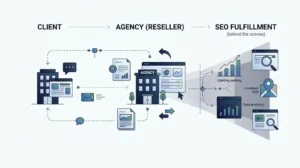
A hybrid model keeps strategy and client relationships in-house and sends repeatable production work to a white label provider. You keep the decisions that clients judge you on, and the provider handles volume work that does not need a salaried hire.
Keep in-house:
- Client communication and account management
- SEO strategy, keyword targeting, and priorities for each client
- Quality review of every deliverable before it reaches the client
Send to a provider:
- Profile setup, posts, and monthly upkeep through white label Google Business Profile management
- Guest posts, editorial placements, and niche edits through white label link building
- City and service page silos, or full site builds, through white label SEO web design
- Answer-first content and schema for ChatGPT, Gemini, and Google AI Overviews through white label AI SEO
Start by sending one discipline to a provider, review the output for 60 to 90 days, then add more. Bring a task in-house only when its volume fills one person’s week. Until then, the provider’s team handles it at a cost that matches your client count.

In-House vs. White Label SEO Decision Checklist
Answer these six questions, then count which column your answers favor.
Question | A “yes” favors | A “no” favors |
Can you keep a full-time SEO specialist busy every week? | In-house | White label |
Can you fund salary, benefits, and tools before the first client pays? | In-house | White label |
Does your client count change from month to month? | White label | In-house |
Do you need local SEO, links, content, and AI search at the same time? | White label | In-house |
Do you need campaigns live in days, not months? | White label | In-house |
Must the work stay inside your own systems for security or compliance? | In-house | White label |
Mostly white label answers: start with a provider and pilot one client. Mostly in-house answers: price the full cost of each hire first. A split result points to the hybrid model.
Frequently Asked Questions
Is white label SEO cheaper than hiring an in-house SEO?
For most agencies, yes. One US SEO specialist averages $71,373 a year in base salary before benefits and tools, while white label local SEO typically costs $500 to $1,500 per month per location. In-house costs less per campaign only when each hire stays fully booked.
How long does it take to start white label SEO compared with hiring?
White label SEO starts in days, while hiring takes months. CELM starts campaigns within a 2-business-day SLA. An in-house hire needs recruiting, onboarding, and training before the work is reliable.
When should an agency hire in-house SEO staff instead?
Hire in-house when SEO is your core product, the workload fills each specialist’s week, or client work must stay inside your own systems. If client volume rises and falls, or you need several SEO disciplines at once, a provider fits better.
Can an agency use in-house SEO staff and white label SEO together?
Yes. In a hybrid model, your team owns strategy, client communication, and quality review, and a white label provider handles production such as Google Business Profile management, link building, and reporting. Start with one discipline and add more after a 60 to 90 day review.
Test White Label SEO With One Client
If your answers point to a provider, test the model on one client before you change how your agency is staffed. CELM has managed 10,000+ campaigns since 2015 and works with 194 agency partners, and every deliverable carries your brand.
Review our white label SEO services to see what you can resell, or read how the SEO reseller program handles onboarding. Plans and pricing are published in the Agency Shop, and you can book a discovery call to scope your first campaign.