$282K a Year in Equivalent Ad Spend: What 27 Months of Local SEO Built for a Florida Injury Firm
Paid search stops producing the moment the budget stops. This Northeast and Central Florida injury, accident, and real estate firm spent 27 months building organic search into a channel now worth an estimated $23.5K a month in equivalent ad spend, a $282K annualized run rate that keeps paying out whether or not the marketing budget moves.
Thirteen Years of Standing Still
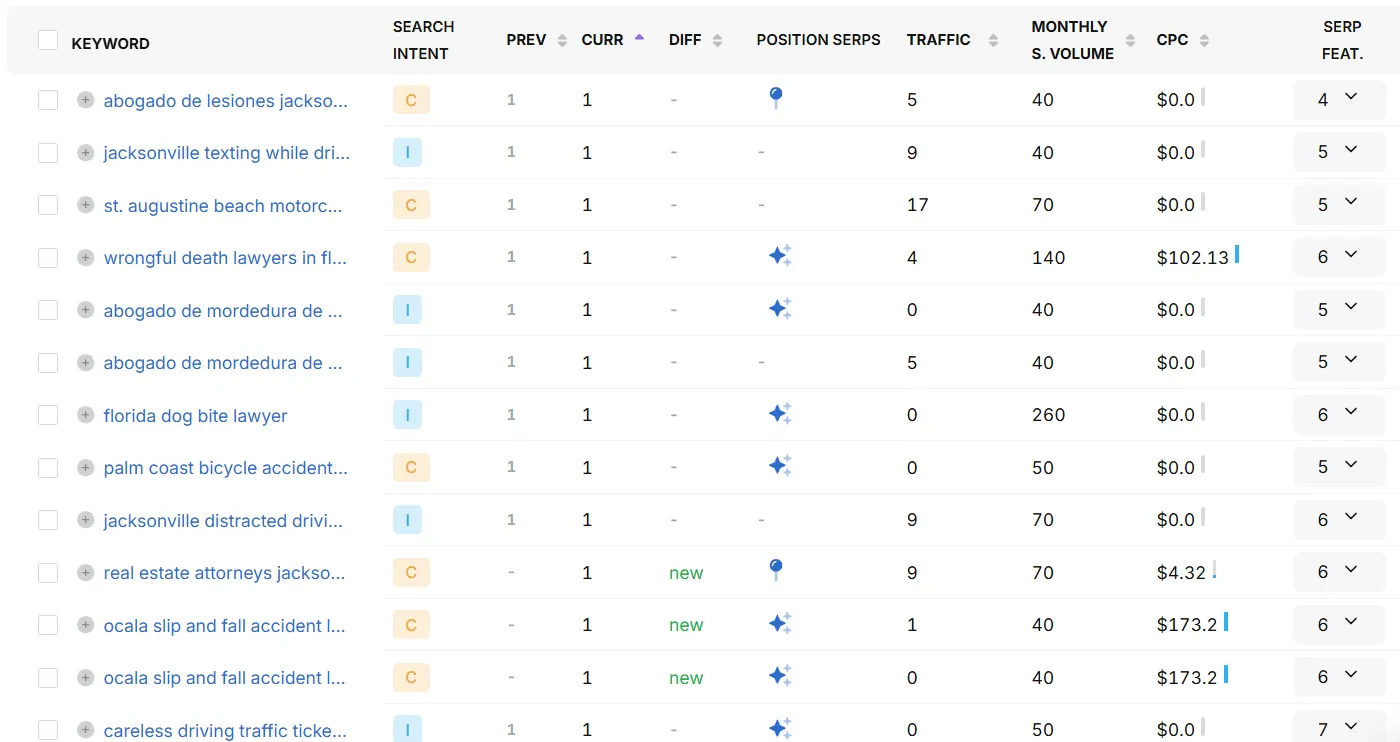
The client is a personal injury, accident, and real estate law firm based in Jacksonville, Florida, with practice-area and location pages reaching into St. Augustine, Palm Coast, and Ocala. Demand for its services arrives in both English and Spanish, across case types from car and motorcycle accidents to wrongful death, dog bites, bicycle accidents, distracted driving, slip and fall, and traffic citation defense, several of them among the most expensive click categories in local legal marketing.
Florida's personal injury market is dense with competition, and a firm's licensing status is public record through The Florida Bar's attorney directory, a reminder that most of the fight for new clients now happens in the search results long before a phone ever rings.
For more than a decade, this domain's organic search presence barely moved: a handful of rankings, negligible traffic, nothing compounding. Every stat in this case study is measured against that baseline, not an industry average, because there was no meaningful external benchmark to chase.
Built to Cover Every Angle, Not Just the Obvious One
Rather than chase a handful of head terms, the campaign was scoped around breadth: enough case-type and location coverage, in both languages the firm's clients search in, that visibility would compound into an owned asset instead of a rented placement.
- Build organic visibility as a durable asset that keeps producing traffic without a recurring ad spend
- Rank a full matrix of case-type pages instead of a single generic injury page
- Build dedicated location coverage across Jacksonville and the surrounding Northeast and Central Florida markets
- Capture Spanish-language search demand with genuine bilingual content, not a single machine-translated page
Case Types Covered
Markets Covered
That kind of topical grouping follows long-standing guidance from Google's own SEO Starter Guide, which recommends organizing similar pages together so search engines can better understand how thoroughly a site covers a subject. A real estate practice area shows up in the same keyword data, indicating the location-page approach extended beyond personal injury alone.
For a look at how the same approach played out for a different firm, see our Personal Injury Law Firm SEO case study. This work sits within our broader local SEO programs.
A Slow Build, Then a Steep Climb, Then a Test of Durability
Growth here did not arrive on day one. After the flat decade shown above, the domain's history shows a modest initial build, followed by a much steeper climb roughly 18 to 20 months into the campaign, a peak, a pullback, and a recovery. That shape is normal, not a warning sign: new practice-area and location pages need time to earn trust, and a growing footprint of topically related content tends to compound rather than add up in a straight line.
We do not have a verified cause for the pullback in the data available, and this case study will not guess at one. What the same window confirms is which numbers kept climbing anyway: keywords holding a top 3 position grew from 63 to 68, positions 4 through 10 grew from 218 to 259, and SERP Features grew from 100 to 103.
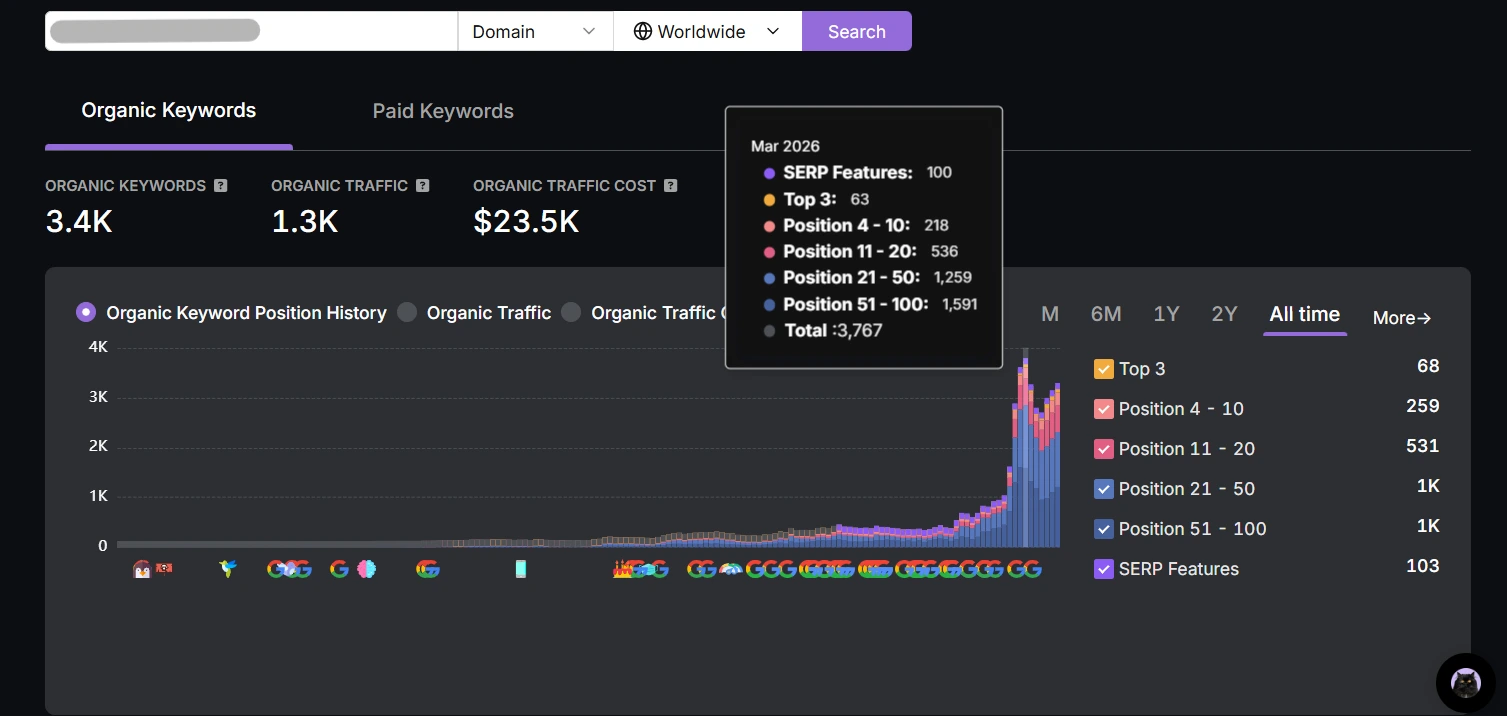
Domain Overview, most recent Search Atlas snapshot.
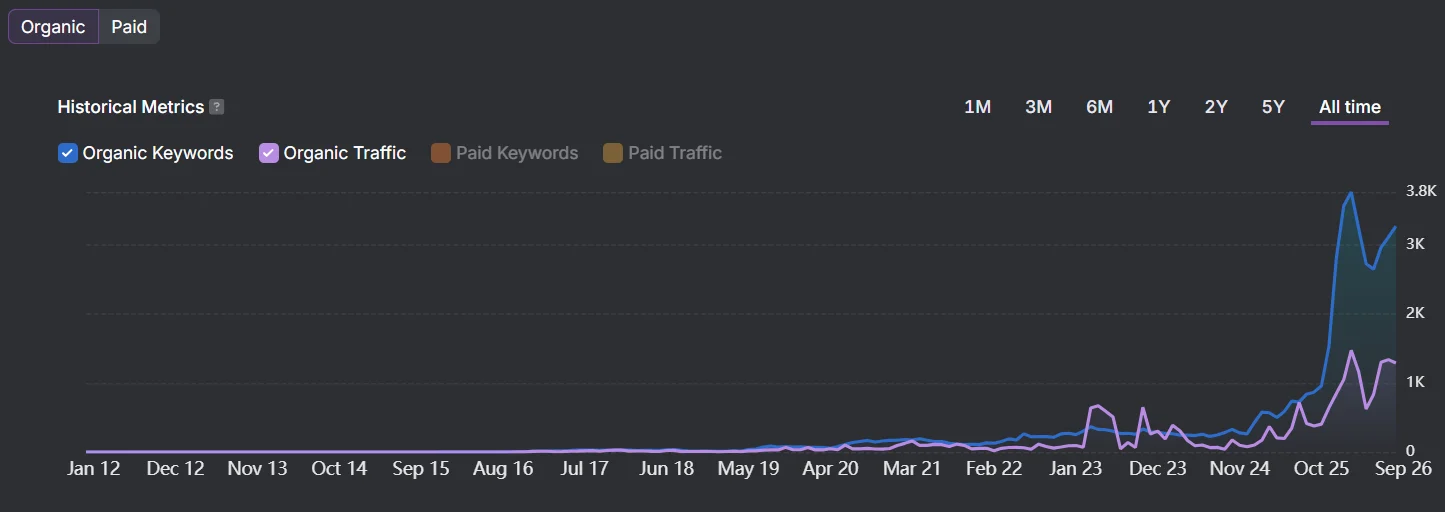
All-time history, January 2012 through September 2026.
Built for How People Actually Search
A meaningful share of the ranked keywords are in Spanish, which points to genuine Spanish-language practice-area content rather than leaving that search volume to English pages alone or relying on a single machine-translated page.
The same page structure that earns traditional rankings, tightly clustered by case type, location, and language, is also the kind of structure AI-driven answer engines rely on to identify topically deep, authoritative sources. We do not have AI-citation data for this specific campaign to report here, and we won't claim a result we can't measure. What we can say is that the underlying content architecture, organized rather than scattered, is built to be legible to both traditional and AI-driven search.
What 27 Months of Ownership Is Worth
From an estimated [INSERT: baseline monthly organic traffic value] at onboarding to $23.5K today, roughly a [INSERT: growth multiple]x increase over 27 months. Pulled directly from the domain's Search Atlas organic research dashboard.
Spread across an estimated 1.3K monthly visits, $23.5K in equivalent ad spend works out to about $18 a visit, in a keyword set where individual clicks run $102 to $173. That is not a vanity metric. It is the media budget the firm no longer has to spend to reach the same audience.
Key takeaway: With more than 3,400 keywords ranked across nine case types and four Florida markets, in two languages, the firm's visibility does not depend on any single term, page, or algorithm update holding steady.
Available Through the Agency Shop
This kind of owned, compounding local search asset, not just a page count, is part of the same local SEO fulfillment agencies can resell under their own brand.
Access the Agency ShopWant This Kind of Asset for Your Firm's Website?
If your firm's visibility still depends on the media budget you spend this month, you are renting it instead of owning it. See what a structured local SEO program can build instead.
See Our Local SEO Programs Talk to Us