

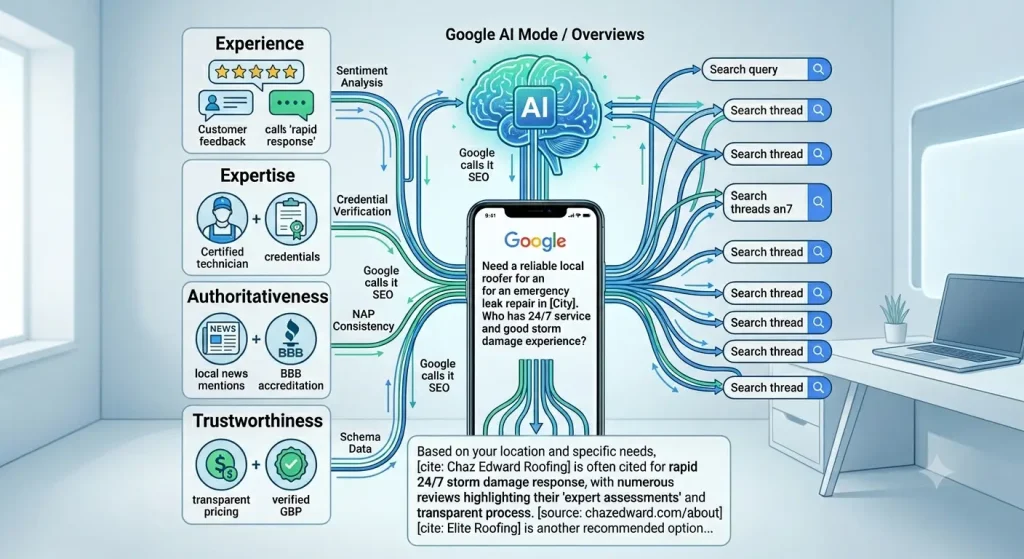
- AI SEO Visibility for Local Businesses
The local business owner's guide to AI Overviews, GEO, and getting cited before your competitors are.
Search is not a list of ten blue links anymore. When a customer asks Google, ChatGPT, or Perplexity for the best roofer, plumber, or law firm in their town, the answer often comes back as a written summary with a few cited sources. The business named in that summary wins the lead. The ones buried below it lose the visit before it starts.
This is the shift behind AI SEO. It is the work of making your business the source that AI engines trust, quote, and recommend when someone nearby is ready to buy. For a local company, this is no longer a side project. AI Mode in Google passed one billion active users per month in 2026, and the share of searches that show an AI answer keeps climbing.
This guide explains what AI SEO means in plain terms, lays out a current strategy built for local businesses, and shows how our team puts the whole system to work for you. By the end you will know what to fix first and how to measure progress.
If you want a head start, our local marketing services already fold these tactics into one managed program, and you can grade your own setup with the free scorecard near the bottom of this page. The official ground rules also come straight from Google, which now publishes guidance on how its AI Overviews and AI Mode features select content.
What AI SEO Means for Your Local Business
AI SEO is the practice of optimizing your online presence so AI-driven search tools surface your business in their answers. That covers Google’s AI features, standalone chat assistants, and the AI agents that now book and buy on a person’s behalf. A few terms come up over and over, so here is what each one means.
AI Overviews and AI Mode
AI Overviews are the AI-written summaries that appear at the top of many Google results. They pull facts from across the web and present a short answer with supporting links. AI Mode is the conversational version a user opens on purpose to ask follow-up questions and compare options. Both run on Google’s core search index and use a “query fan-out” method, where the engine issues several related searches behind the scenes and stitches the best pieces into one response. Your job is to be one of those trusted pieces.
GEO and AEO, and Why Google Calls Them SEO
GEO stands for generative engine optimization. AEO stands for answer engine optimization. Both describe the same goal: earn visibility inside AI-generated answers. In May 2026, Google published a guide stating that, for its own search features, this work is still SEO. You can read the official guidance on optimizing for generative AI features straight from Google. The same foundations that earn rankings, helpful content, clean structure, and real trust, also earn citations. You do not need a separate playbook for Google. You need the fundamentals done well, then tuned for how machines read.
AI Assistants Beyond Google
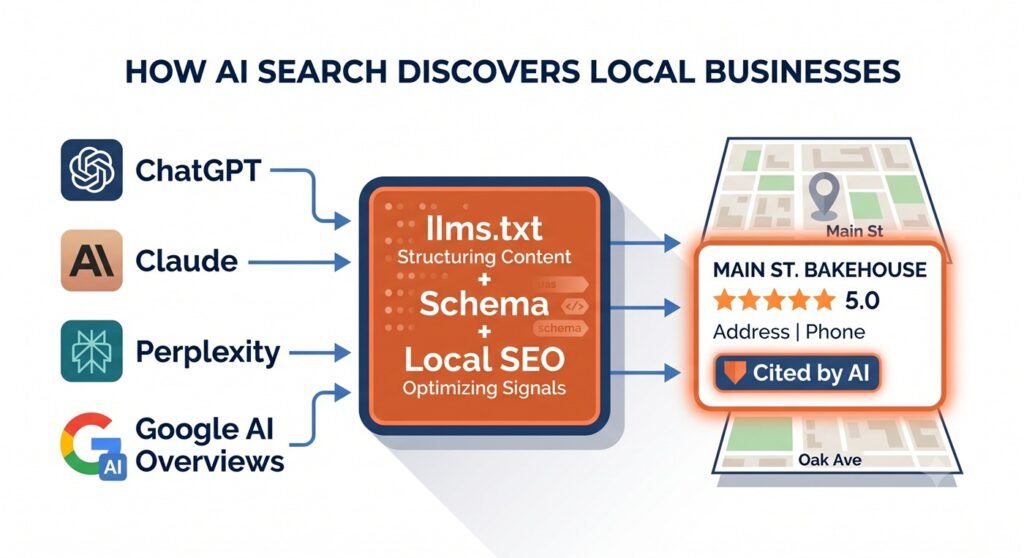
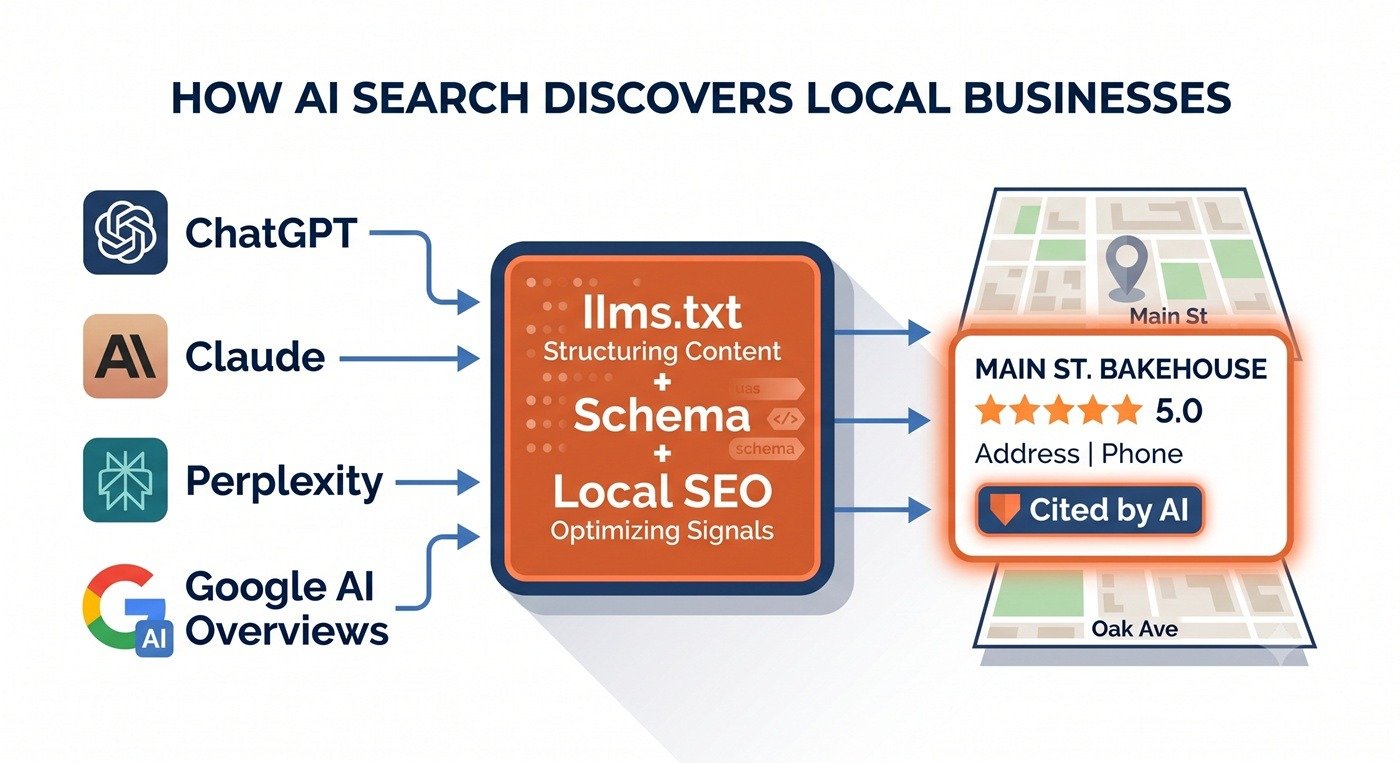
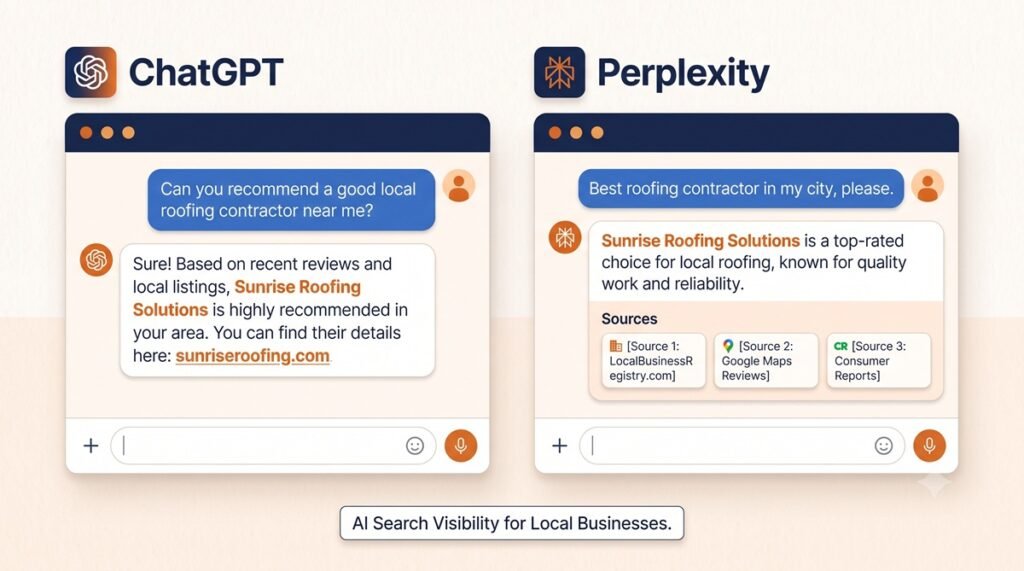
Google is one engine. Your customers also ask ChatGPT, Perplexity, Microsoft Copilot, and the Gemini app for local recommendations. These tools do not all share Google’s index. Some crawl the open web with their own bots, some lean on partner data, and some read special files that you can publish to guide them. Getting found in AI search means earning a place across this whole set, not just one box on a results page. That broader reach is the reason a complete program matters more than any single trick.
AI Agents That Act for Customers
The newest shift is agentic search. AI agents no longer just answer questions, they take action: comparing providers, filling forms, and booking or buying on a customer’s behalf. For a local business, that raises the bar. An agent can complete a job only if it can read your prices, your services, and your booking options without friction. That means structured data on every service, clear and current service and pricing pages, and content an agent can parse and act on. Hide that behind images, PDFs, or a funnel that needs a phone call and the agent skips you and the sale. We build the agent-accessible pages and data that let these tools choose your business and finish the task.
In short: AI SEO is the work of becoming the source AI engines cite. For Google it builds on classic SEO. For the wider set of assistants it adds extractable content, clean data, and crawler access.
Why AI Search Changes the Game for Local Businesses
For years the local playbook was simple. Rank in the map pack, rank in the blue links, collect the click. AI search bends that model in three ways, and each one favors businesses that prepare.
First, many searches now end without a click. The customer reads the AI answer and acts on it. If your business is named in that answer, you still win the lead. If not, you are invisible even when your website ranks on page one below the fold. Being the cited source matters more than holding a rank.
Second, AI engines reward trust signals that a small business can build. Reviews, consistent business details, and genuine mentions across the web all feed the picture an AI forms of who is reputable in your area. A strong Google Business Profile optimization and a clean reputation profile do double duty here, helping both classic rankings and AI citations.
Third, the bar for clarity went up. An AI engine reads a page in one pass and lifts the part that answers the question. Pages that bury the answer in fluff get skipped. Pages that state the answer in plain language get quoted. The same care you put into ranking, covered in our guide on how to rank in Google Maps and local search, now pays off twice.
The 2026 AI SEO Strategy for Local Businesses
Here is the full strategy, in the order we run it. Each step strengthens both your classic rankings and your odds of being cited by AI. None of it depends on gimmicks. It depends on doing the right things in the right sequence.
1. Build a Source-Worthy Website Structure
AI engines favor sites that prove depth on a topic and a place. That means a clear hub for each service, child pages for each sub-service, and a page for each city or area you serve, all linked in a tidy silo. This topical authority tells an engine your business is a real authority on roofing in Tampa or family law in Boise, not a thin listing. Businesses with many locations need an even tighter plan, which is where a managed multi-location SEO structure keeps every market organized and crawlable.
2. Answer Questions the Way AI Extracts Them
Write the answer first, then explain. Open key sections with a short, direct response of 40 to 60 words, then add detail below. Use clear H2 and H3 headings so a machine can map the themes. Add the real questions people ask, pulled from People Also Ask, and answer each one in plain language. Short TL;DR summaries, numbered steps, and tight comparison points all give an engine a clean block to quote. Our semantic SEO prompts for ChatGPT help shape this kind of extractable content at scale.
Who wrote it matters as much as what it says. AI engines weigh Experience, Expertise, Authoritativeness, and Trustworthiness, the signals Google groups as E-E-A-T, to decide whose content to cite. Put real author bios and bylines on your posts, name the people behind the work with their credentials, and treat your About page as a trust document that states who you are, how long you have served the area, and what licenses or certifications you hold. A page with a named, qualified human behind it earns citations over an anonymous wall of text.
3. Lock Down Your Google Business Profile and NAP
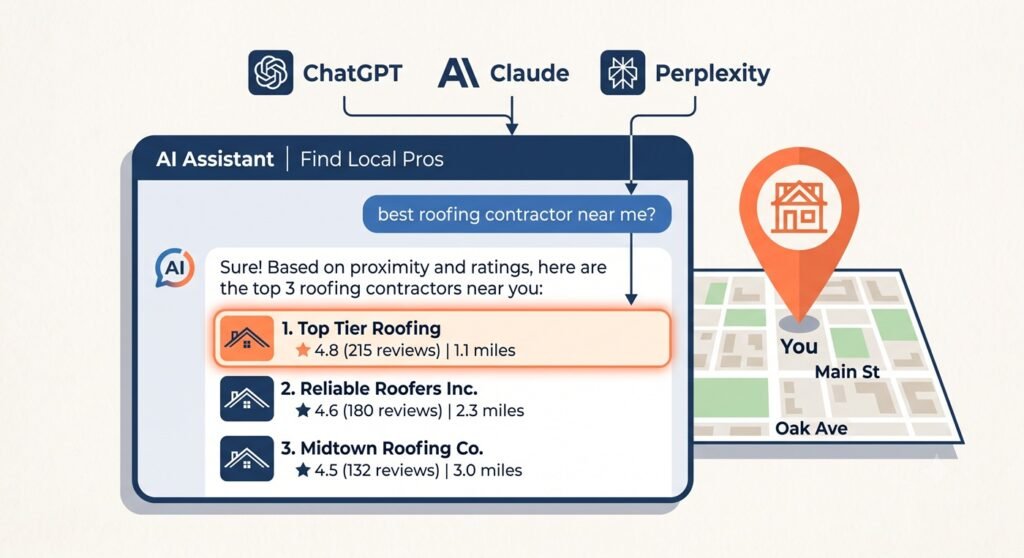
Your Google Business Profile is still the anchor of local AI answers. Keep the categories, services, hours, and description complete and current. Then make sure your name, address, and phone match across every directory, social profile, and citation. AI engines cross-check these details to decide whether you are the same trustworthy business everywhere they find you. One wrong address or old phone number chips away at that trust. Do not stop at Google either: Microsoft Copilot pulls its index from Bing, so claim Bing Places and verify your site in Bing Webmaster Tools to open that door too.
4. Earn Reviews and Brand Mentions Across the Web
Reviews are proof of real customers, and AI engines read them as a strong vote of confidence. A steady flow of fresh, detailed reviews on Google and the platforms that matter in your trade beats a one-time burst. Beyond reviews, genuine mentions in local news, community posts, and industry sites build the web of references an engine uses to confirm you are prominent in your market. Our reputation and brand management work keeps reviews coming and your name present where it counts, and our social media for local SEO ranking program feeds the same signal.
Citation diversity is its own job: ChatGPT and Perplexity lean hard on sources outside Google. They pull from Reddit threads, Yelp, the Better Business Bureau, and industry directories when they build an answer. That makes seeding reviews and genuine mentions across these platforms a separate tactic from your Google-focused reputation work. A business that looks strong on Google but sits absent from Reddit and the directories an AI trusts can still be left out of the answer. We seed and monitor mentions across the full set, not just the profiles Google cares about.
5. Add Structured Data So Machines Understand You
Schema markup is code that labels your content so a machine reads it without guessing. LocalBusiness, Service, FAQ, and Review schema spell out your hours, your offerings, and your ratings in a format engines parse with ease. While Google says its own AI features do not require special markup, valid structured data still earns rich results and removes doubt for the wider set of crawlers. You can study the field in our guide on schema markup for local SEO, build your own with our schema generator tool, and check the spec at schema.org’s LocalBusiness page.
6. Open the Door to AI Crawlers
Many AI engines send their own bots to read your site. The ones to welcome in your robots.txt file are GPTBot (OpenAI and ChatGPT), PerplexityBot (Perplexity), ClaudeBot (Anthropic), and Bingbot, which also feeds Microsoft Copilot. If your robots file or hosting setup blocks them, you cannot be cited no matter how good your content is. To check, open yourdomain.com/robots.txt in a browser and confirm none of these bots sit under a Disallow rule, then verify crawl access in Google Search Console. Here is where the engines split. Google reads your standard HTML pages for AI Overviews and AI Mode, so for Google you do not need a special file. The non-Google engines work in a different way: Perplexity, Claude, and the OpenAI agents reach for a clean Markdown file when one exists, because Markdown is leaner to parse and saves room in their token context window. That is what an llms.txt file gives them, a tidy map of your most useful pages in plain Markdown. Skip it and you can still surface in Google while losing ground on the fast-growing pool of non-Google AI traffic. We handle this step with our own AI Ready plugin, covered later on this page, and you can build a starter file with our AI search llms.txt file generator.
7. Track Your AI Visibility
You cannot improve what you do not measure. Watch how your brand shows up in ChatGPT, Gemini, Perplexity, and Copilot for the questions your customers ask. Track which pages earn AI citations, monitor your Search Console performance for AI-driven traffic, and note when a competitor takes a spot you want. This loop tells you where to push next. You can see the kind of movement this produces in our local SEO results and in our local SEO case studies.
The table below sums up how the old approach and the AI-ready approach differ, and which parts our team handles for you. Both still matter. The point is to do both at once.
Aspect | Classic Local SEO | AI SEO for Local | CELM Handles This |
Main goal | Rank in the blue links and map pack | Get cited in AI Overviews, AI Mode, and chatbot answers | ✓ Covered |
Core signal | Keywords and backlinks | Source-worthy content, entities, and structured data | ✓ Covered |
Content shape | Long pages built for readers | Clear answers a machine can lift in one pass | ✓ Covered |
Discovery | Google crawl and index | Google crawl plus access for AI bots like GPTBot | ✓ Covered |
Win condition | A click from a ranking | A citation, a brand mention, or a click from an answer | ✓ Covered |
What you measure | Rank and organic traffic | AI citations, share of answer, and assisted leads | ✓ Covered |
How CELM Handles AI SEO for You
Every step above takes time, tooling, and a system that runs each month without a miss. That is the work we do for local businesses across the country. When you hand AI SEO to our team, you get one program that covers the whole strategy on this page, not a stack of one-off tasks you have to manage.
We build the source-worthy site structure, write the extractable content, and keep your Google Business Profile and citations clean and consistent. We run the review engine and brand mention program that earns trust signals, implement and validate your structured data, and open the right doors for AI crawlers. We add conversational coverage with AI assistant chatbots that answer and capture leads at any hour. Then we track your visibility across the AI engines and report what moved.
Inside the program, that means a complete set of moving parts handled for you: an AI bot access audit of your robots.txt and hosting, llms.txt deployment and upkeep through our AI Ready plugin, full E-E-A-T implementation across author bios, credentials, and your About page, cross-platform citation seeding on Reddit, Yelp, the BBB, and the directories AI engines trust, and a report each month on how your visibility is moving across the AI engines. It runs as one managed service, not a pile of loose tasks you have to chase.
The result is a business that shows up when a customer asks an AI for help, on Google and beyond. You stay focused on the work you do best while we keep your name in the answer. If you would rather see your current standing first, start with a free local SEO audit, then book a call to map the plan.
Meet AI Ready: The Plugin Behind Step Six
Publishing an llms.txt file is one of the steps above, so we built a tool that handles it for you. AI Ready is our WordPress plugin, and it turns your whole site into two clean Markdown files that AI engines can read in a single pass. You can view ours right now: the short index at www.chazedward.com/llms.txt and the full content map at www.chazedward.com/llms-full.txt.
What it builds
The plugin writes two files at the root of your site. The first, llms.txt, is a short index: your site name, a one-line description, a link to the full file, and a grouped list of your key pages with brief notes. It is small enough to fit inside an AI’s context window. The second, llms-full.txt, is the full content of the pages you choose, rendered as Markdown with each page’s title, URL, and last-updated date. Builder wrapper code, scripts, and styles are stripped out, so the model gets your words and nothing else.
Why Markdown, and Why It Helps
AI engines read text, not page design. The same content written in HTML can cost two to four times the tokens of its Markdown version, which crowds the model’s limited context. Markdown keeps your content lean, so more of it fits when an AI forms an answer. To be plain about it, llms.txt is not a ranking signal. It is a delivery format. Without it, an AI crawler has to download your HTML, strip out the menus, footers, and cookie banners, and guess at your real content. With it, you hand the model the exact version you want it to read. Google says its own AI features do not need the file, and the cost to add it is near zero, so it stays a smart move for the wider set of assistants and agents.
How It Runs on Your Site
AI Ready is built to stay out of your way. It rebuilds both files on every content change, a publish, an update, or a delete, so there is nothing to remember. It writes static files that your web server delivers on its own, which means an AI crawler pulling a large file does not tie up your site. A checkbox on each page keeps thank-you pages, gated offers, and internal pages out of the files. A dashboard shows your file size, an estimated token count, and how much of an AI’s context window your content would fill. Explore it next to our other free SEO tools, or let the plugin keep the full version current for you.
Get AI Ready Free
The plugin is free, and the AI Readiness Scorecard below is how you get it. Complete the scorecard, enter your email, and your AI Ready download arrives on the spot, the same agent-ready infrastructure we install for clients. There is no other download link to hunt for: the scorecard is the gate. Prefer to skip the setup? Our team installs it and runs the full program for you.
Free Tool: Scan Your Site’s AI Readiness
Before you change a thing, find out where you stand. Enter your website address and our AI Readiness Scorecard runs an instant check, then hands you a score out of 100, a clear grade, and a fix-first list. It takes about two minutes, and you do not need to know a single technical term to use it.
AI Readiness Scorecard
Enter your site for an instant read on how visible your business is to AI search tools like Google AI Overviews, ChatGPT, and Perplexity. About two minutes.
The tool grades the eight signals that decide whether AI engines can find and cite your business. Three of them it reads from your site on the spot: AI bot access in your robots.txt, whether an llms.txt file is present, and the schema markup on your pages. The other five you confirm with one tap each, since they live off your site: Google Business Profile completeness, NAP consistency, review volume and recency, content extractability, and cross-platform brand mentions. Put together, you get a true read instead of a guess.
So you know the path before you start: enter your URL, confirm the few off-site signals, then see your score, your fix-first list, and a direct download for the AI Ready plugin right in your results, no email required. Want the full program instead of the do-it-yourself route? Contact our team and we will take it from here.
Frequently Asked Questions
What is AI SEO in simple terms?
AI SEO is the work of making your business the source that AI search tools trust and quote. When someone asks Google’s AI, ChatGPT, or Perplexity for a local recommendation, AI SEO improves the odds that your business is named in the answer with a link back to you.
Is AI SEO different from regular SEO?
For Google’s AI features, the foundations are the same. Google states that GEO and AEO are still SEO. The difference is emphasis. AI SEO leans harder on clear, extractable answers, consistent business data, strong reviews, and crawler access, since those signals decide what an engine quotes.
Do I need an llms.txt file to show up in AI search?
Google says you do not need one for its own AI Overviews and AI Mode. It still helps for the wider set of AI assistants and for agent-readiness, and it costs little to add. Treat it as a useful extra, not a requirement for Google.
How long does AI SEO take to show results?
It depends on your starting point and your market. Foundational fixes like profile cleanup and structured data can show effect within weeks. Building topical depth, reviews, and the mentions that earn steady citations is an ongoing effort that compounds over months.
Can a small local business compete in AI search?
Yes. AI engines reward trust and relevance, not just budget. A focused local business with a complete profile, clean data, real reviews, and clear answers can be cited ahead of larger brands that neglect these signals.
What is agentic search, and does it affect my business?
Agentic search is when an AI agent takes action for a customer, such as comparing providers and booking a job, not just answering a question. It affects you if a customer can act through an AI. To be chosen, your services, prices, and booking options need to be in clear, structured, agent-readable form. Hide them behind images or a funnel that needs a phone call and the agent moves on.
Ready to get found in AI search?
Grade your setup with the AI Readiness Scorecard, grab the AI Ready plugin, then let us run the full program. Start with a free local SEO audit or contact our team to build your plan.