- Local Social Media Marketing
Social Media Is Reshaping Local SEO and Google Maps Rankings
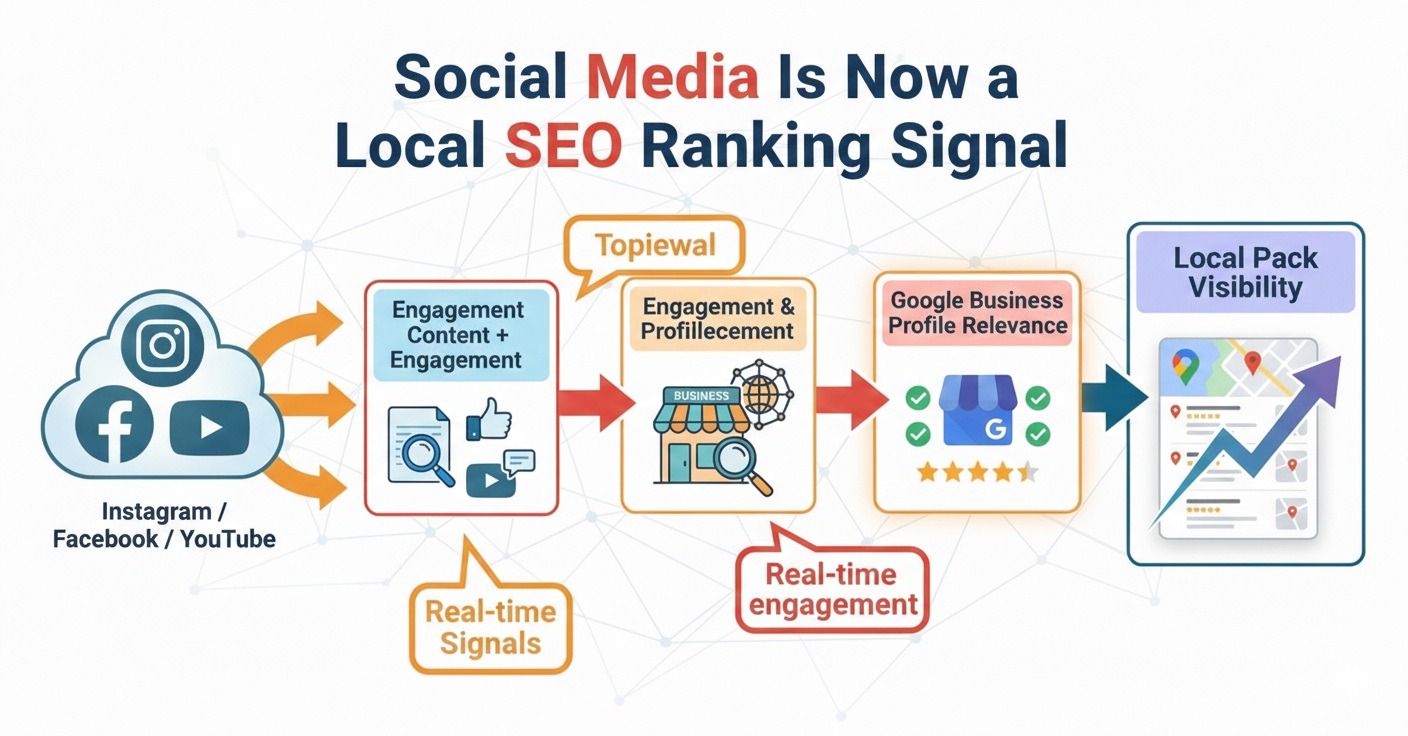
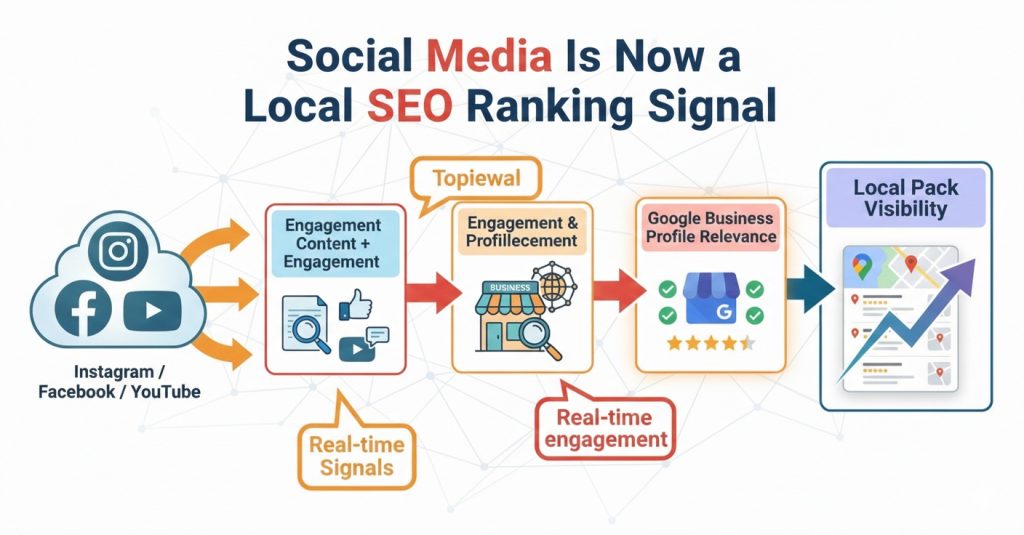
Social Media Is Now a Local SEO Ranking Signal.
For years, marketers have been stuck on the social media hamster wheel.
You create a post.
It gets a burst of likes, a few comments, maybe a share or two.
Then—almost immediately—it disappears into the algorithmic void.
The lifespan is short.
The effort is constant.
And the long-term return often feels questionable.
That mental model shaped how businesses treated social media: temporary engagement, not infrastructure.
But that reality has quietly—and fundamentally—changed.
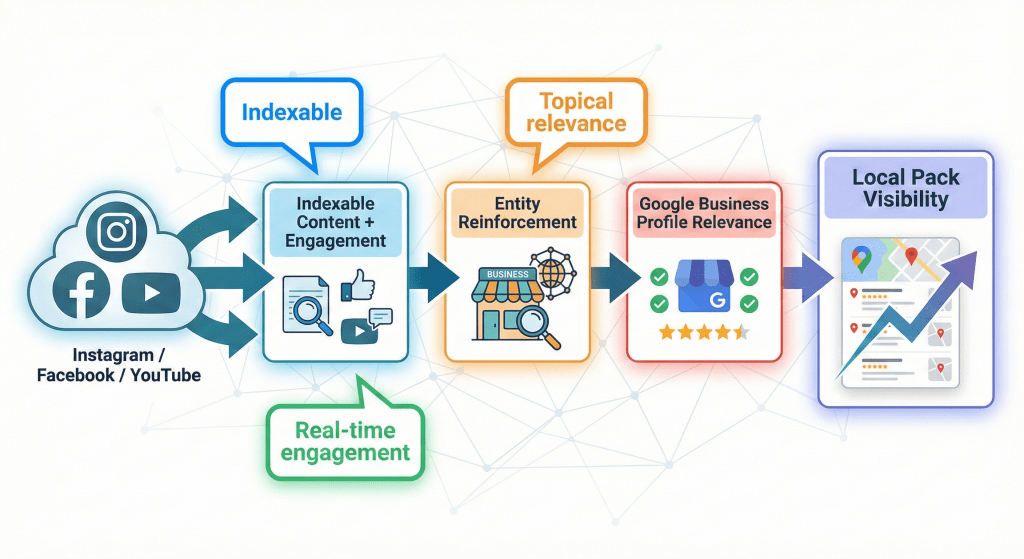
Recent shifts from Google and major social platforms have transformed social media from a fleeting engagement channel into something far more powerful: a permanent, search-visible asset that directly influences how Google understands and ranks your business.
Most businesses haven’t caught up yet.
Those that do first will gain a disproportionate advantage.
Social media is no longer just a branding channel. Google crawls and indexes public social posts to understand business entities, relevance, and engagement. When social content is aligned with your services and locations—and linked to your Google Business Profile—it can influence local SEO and Google Maps rankings. Businesses that stack social + GBP signals + geo-targeted assets often gain visibility faster than those relying on blogs and citations alone.
Social Media Posts Are No Longer Temporary — They’re SEO Assets
The single most important change most businesses missed is this:
Public social media content is now being indexed by Google.
That means your posts are no longer confined to a platform feed. They’re entering Google’s search ecosystem.
To understand the impact, think of Google as a massive global index—a library catalog of the internet. For years, platforms like Instagram operated more like private libraries. Their content existed, but it wasn’t cataloged in Google Search in a meaningful way.
That door is now open.
Public posts from professional Instagram accounts—including posts, Reels, and carousels—are eligible to appear in Google search results. Stories and private content remain excluded, but the implications are enormous.
This is not speculative. It’s already happening:
- Instagram and Facebook posts are appearing directly in Google results
https://verdemedia.com/blog/instagram-facebook-posts-indexed-in-google
With nearly 40% of modern search results now featuring some form of social content, the value of a post has changed completely.
What used to decay in 48 hours can now drive discovery for months or years.
Your social feed is no longer just engagement.
It’s an expanding archive of indexable content tied to your brand.
Google Doesn’t See Channels — It Sees a Business Entity
The biggest mistake businesses still make is thinking in silos.
Website.
Google Business Profile.
Social media.
Separate strategies. Separate teams. Separate goals.
That’s not how Google works anymore.
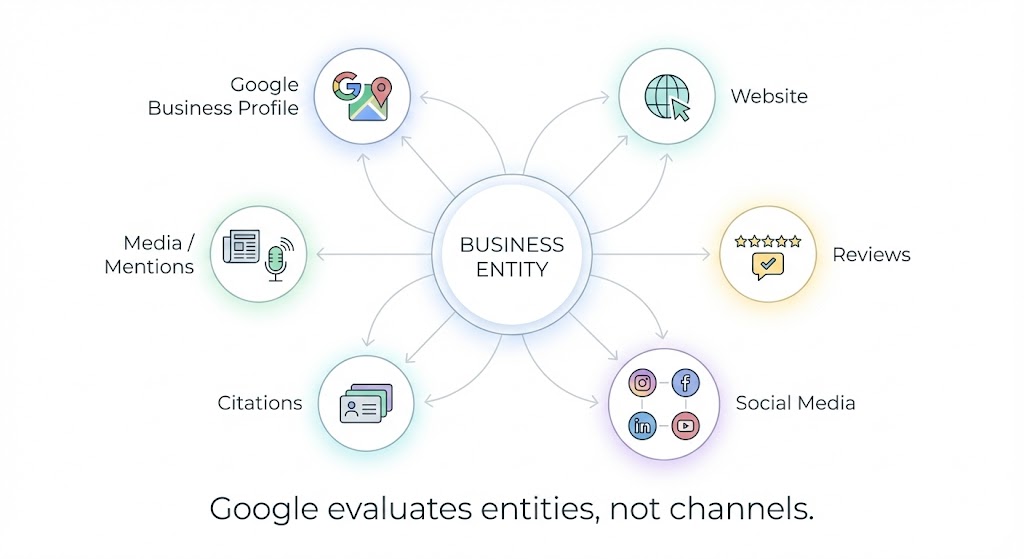
Google evaluates businesses as entities—real-world brands with signals distributed across the web. Your website, GBP, reviews, and social media profiles are all inputs into a single entity graph.
This isn’t theory.
Google explicitly confirms it crawls social media to learn about your business:
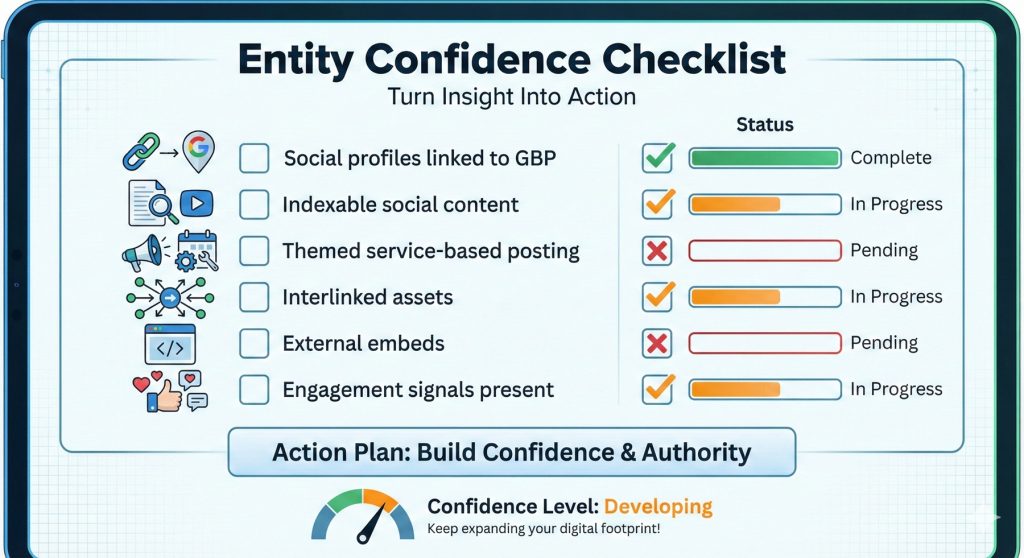
- Google Business Profile documentation confirms social links help Google understand your entity
https://support.google.com/business/answer/13580646
In other words, your social presence feeds Google’s understanding of:
- Who you are
- What you do
- Where you operate
- How users engage with your brand
Once you understand this, local SEO stops being about optimizing isolated assets and becomes about building confidence in a unified business entity.
That confidence is what rankings are built on.
Focused Social Activity Can Move Local Rankings Faster Than Blogs
Here’s where the advice gets uncomfortable for traditional SEOs:
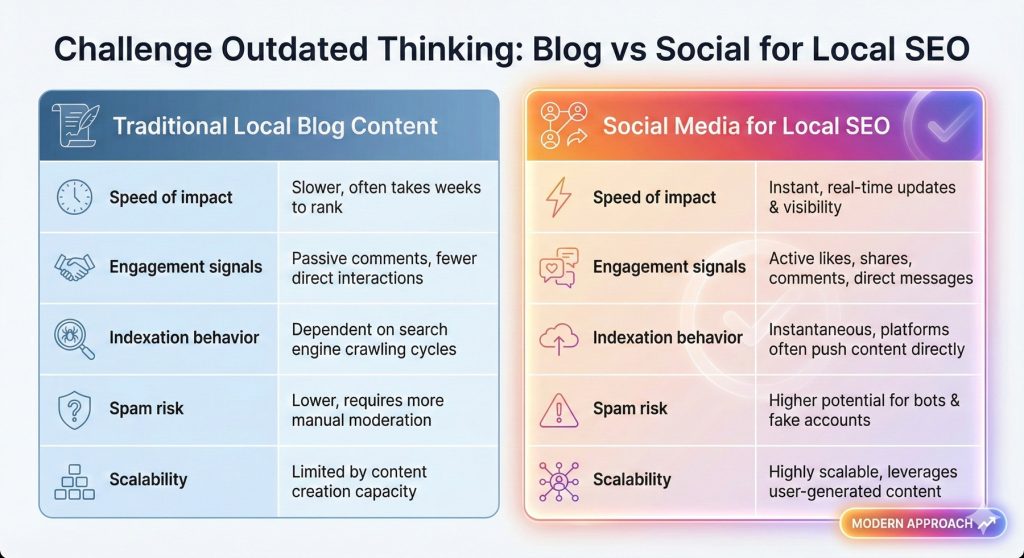
In today’s landscape, focused social media activity can influence local visibility faster than blogging.
Why?
Because the local blog ecosystem is saturated.
AI-generated content has flooded local SERPs, making it increasingly difficult for new posts to stand out. In some cases, aggressive blogging has become a net negative—adding noise instead of authority.
Social content behaves differently.
It provides signals Google values and trusts:
- Real-time engagement
- Visual proof (photos, videos, people, locations)
- Geo-contextual content
- Brand interaction that’s difficult to fake at scale
Consider this example:
A plumbing company wants to rank for water heater repair in its city.
A single blog post competes against hundreds of similar pages.
But a series of Instagram Reels showing:
- Technicians on-site
- Repairs in real homes
- Explanations of common issues
- Geotagged locations
…can compound relevance for that service much faster, especially when connected to the Google Business Profile.
This pattern is being observed repeatedly across service industries.
Google Is Actively Syncing Social Content Into Business Profiles
If indexing wasn’t enough proof, Google took it a step further.
Google recently introduced a Business Profile feature called “What’s Happening”, allowing businesses to surface timely updates directly at the top of their profile.
The revealing part?
Google can automatically pull posts from connected Facebook and Instagram accounts into the GBP.
This isn’t passive crawling. It’s active integration.
- Google testing direct social sync into Business Profiles
https://www.seroundtable.com/google-business-profiles-whats-happening-39403.html
The rollout currently targets restaurants and bars in select countries, but the trajectory is obvious:
Social media is becoming a first-class input for local search products.
Ignoring this isn’t conservative. It’s risky.
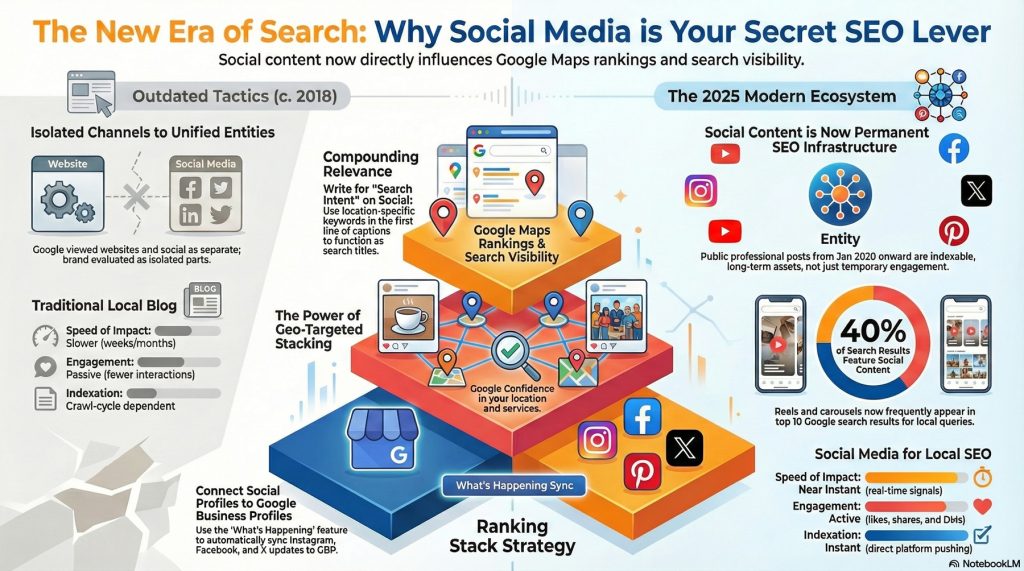
Winning Isn’t About Posting More — It’s About Stacking Signals
The next wave of local SEO wins won’t come from volume.
They’ll come from orchestration.
This is where most strategies fall apart.
Posting randomly doesn’t build authority.
Posting consistently without structure doesn’t build relevance.
What works is stacking.
What Stacking Actually Means
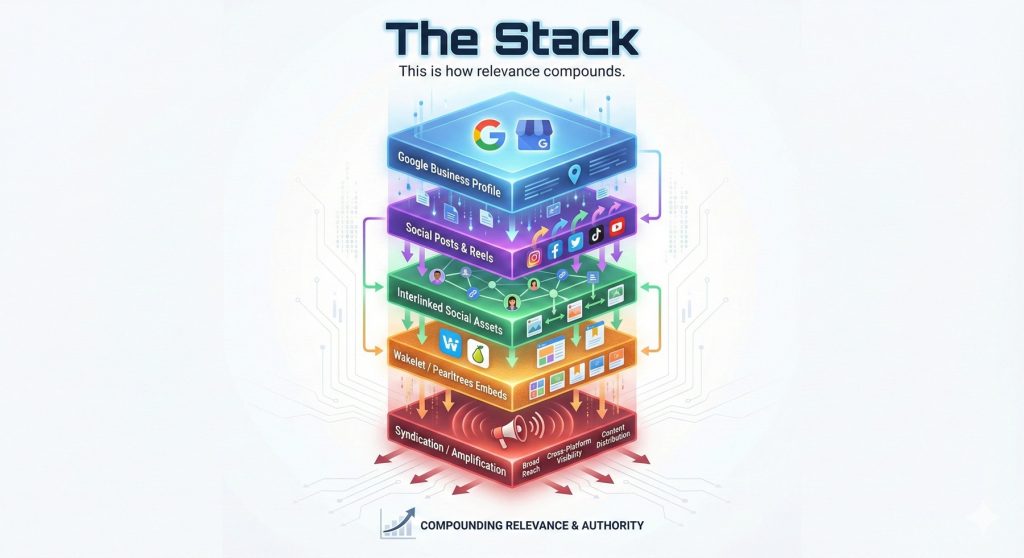
Stacking is the deliberate process of creating thematically aligned content and reinforcing it across platforms so every signal supports the same narrative.
Here’s how it works in practice:
- Create Themed Media
Develop social posts, Reels, and videos around a specific service + location (e.g., Emergency Roof Repair in Dallas). - Interlink the Assets
Link social posts to each other and back to the Google Business Profile. - Curate and Embed
Organize the content into curated collections using platforms like Wakelet or Pearltrees. - Build Geo-Targeted Maps
Embed these assets into geo-specific maps (e.g., BatchGeo) tied to service areas and GBP locations. - Amplify and Syndicate
Distribute the stack through press releases, local guest posts, and citations that reinforce the same entity signals.
Each layer validates the others.
The result isn’t one ranking signal.
It’s confidence at scale.
Related Reading: The Social Media Stacking case study.
Why This Works: Google Needs Confidence, Not Tricks
Google doesn’t rank businesses because of one magic switch.
It ranks businesses it trusts.
Trust is built when:
- Signals are consistent
- Content corroborates itself across platforms
- Location relevance is reinforced repeatedly
- Engagement looks real and organic
Stacking creates a signal ecosystem that tells Google, repeatedly and clearly:
“This business is real.
This business is relevant.
This business belongs here.”
That’s how the map pack is won now.
The Future of Search Is Social-Integrated
The lines between social media and SEO aren’t blurring anymore.
They’re gone.
Every post, video, and update is now:
- A brand signal
- An entity signal
- A discovery surface
The businesses that win over the next few years won’t be the ones producing the most content.
They’ll be the ones orchestrating the strongest signal ecosystems.
Social media is no longer optional.
It’s infrastructure.
The only question left is:
Now that every post can be a front door to your business on Google…
what will you build with it?
Want to see what this looks like in practice?
Check out our Maps Social Media Service to see how we are engineering better visibility everyday using strategic social media.
Final Thoughts
This isn’t theory.
I’ve spent the last 12 months testing, refining, and deploying this exact approach across real businesses and competitive markets.
You can see the results here.
And the full case study + white paper here.
If you want this built and managed for you, we offer Maps Social Media services designed specifically for local visibility.
Agencies can access bulk pricing inside the Agency Shop.
Local SEO didn’t break.
It expanded.
And social media is now part of the core signal set, whether people are ready for that or not.
References & Supporting Sources
- Google Business Profile Help: Social Media Links & Entity Data
https://support.google.com/business/answer/13580646 - Instagram & Facebook Posts Indexed by Google
https://verdemedia.com/blog/instagram-facebook-posts-indexed-in-google - Google Business Profile “What’s Happening” Social Sync
https://www.seroundtable.com/google-business-profiles-whats-happening-39403.html - Observed Social Activity & Local Pack Movement https://www.linkedin.com/posts/valentina-vasileva-4656837a_have-you-noticed-this-pattern-instagram-activity-7416755756735041537-v2NO