


- Reputation Management
When Negative Reviews Aren't Actually Reviews
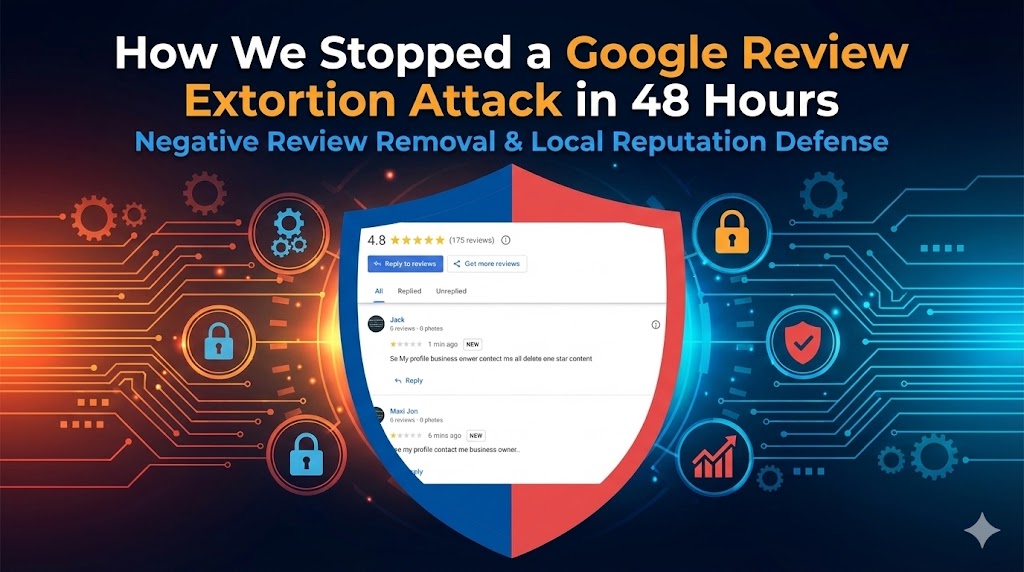
A real case study on fighting fake negative reviews and protecting your business reputation.
At 12:30 PM on December 5th, 2025, our team received an urgent email from a long-time client:
“We are under a review attack! We are getting a 1 star review every hr or so“
This wasn’t a case of legitimate customer complaints. This was something far more sinister—and unfortunately, increasingly common:
Google review extortion.

The Anatomy of a Review Attack
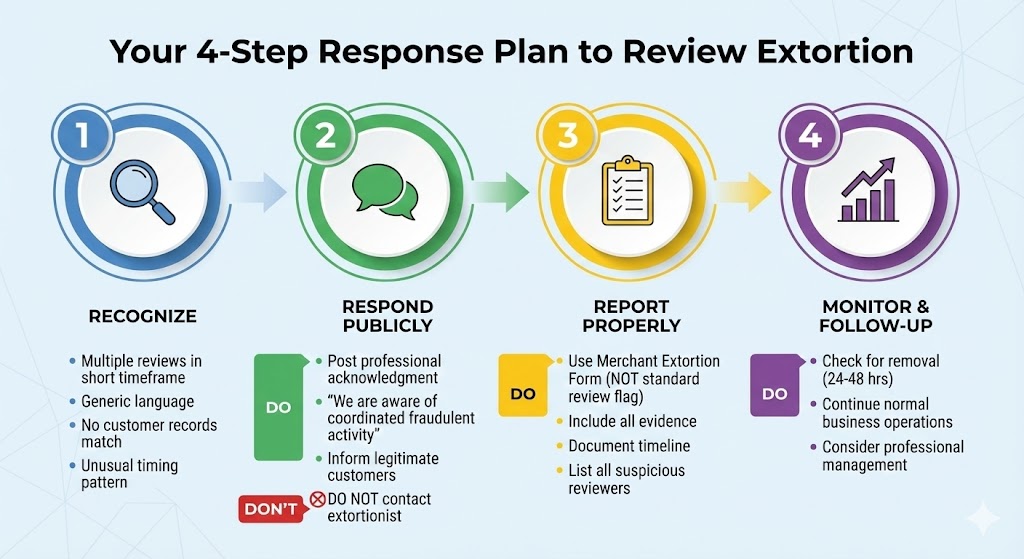
Within hours, the client’s Google Business Profile had been hit with seven suspicious 1-star reviews. The red flags were everywhere:
- Reviews appeared at regular intervals (approximately one per hour)
- Generic, vague language that didn’t mention specific services
- Reviewers claiming to be “Local Guides” but with no review history
- Reviews posted at 5 AM—before business hours
- None of the reviewers appeared in the client’s customer database
- The final review contained the smoking gun: “See my profile contact me business owner..“
This last detail confirmed what we suspected:
this was a merchant extortion attempt—attackers flooding a business with fake negative reviews to damage their reputation, then offering to remove them for a fee.

Our Immediate Response Strategy
When reputation is under attack, speed matters. Within minutes of receiving the alert, we took action:
Step 1: Acknowledge and Document (12:33 PM)
We immediately responded to our client, reassuring them that Google has systems in place to handle these attacks and that we were beginning the reporting process.
Step 2: Public Transparency (12:41 PM)
Rather than leaving the fraudulent reviews unanswered, we posted this response to each one:
“We are aware that our profile is currently the target of a malicious spam attack involving numerous fraudulent 1-star reviews. We have reported this coordinated activity to Google and are awaiting resolution. We appreciate the patience of our genuine customers.”
This accomplished three critical goals:
- Informed legitimate customers about what was happening
- Signaled to Google that coordinated fraudulent activity was occurring
- Refused to engage with the extortionist directly
Step 3: Report to Google’s Merchant Extortion Team (12:52 PM)
Most businesses don’t know this exists, but Google has a specialized Merchant Extortion reporting form specifically designed for these situations. This isn’t the standard review removal request—it’s a direct channel to Google’s fraud prevention team.
We submitted a comprehensive report including:
- Timeline of suspicious review activity
- Names of all suspicious reviewers
- Evidence of the extortion attempt
- Links to reviewer profiles showing no legitimate review history
- Documentation that none were actual customers
support.google.com/business/contact/merchant_extortion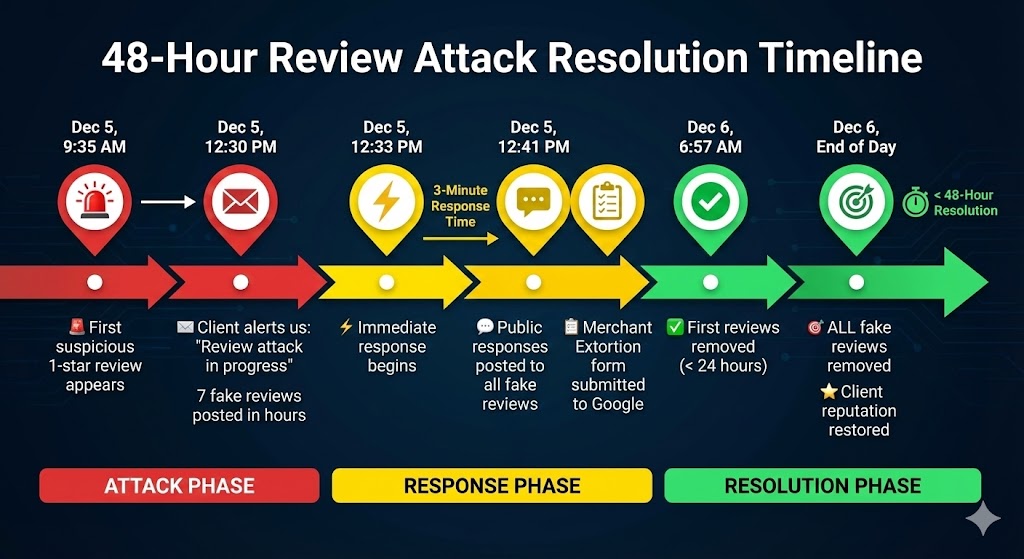
The Critical Mistake to Avoid
The extortionist’s message said: “See my profile contact me business owner..“
We advised the client never to make contact. This is crucial—engaging with extortionists:
- Validates that the tactic works
- May expose you to further scams
- Could compromise your business information
- Won’t actually resolve the situation
Legitimate customer complaints don’t ask you to “contact them through their profile.” This is the hallmark of a scam.

Results: Swift Justice
The fake reviews began disappearing by December 6th at 6:57 AM—less than 24 hours after our report. By the end of that day, all fraudulent reviews had been removed.
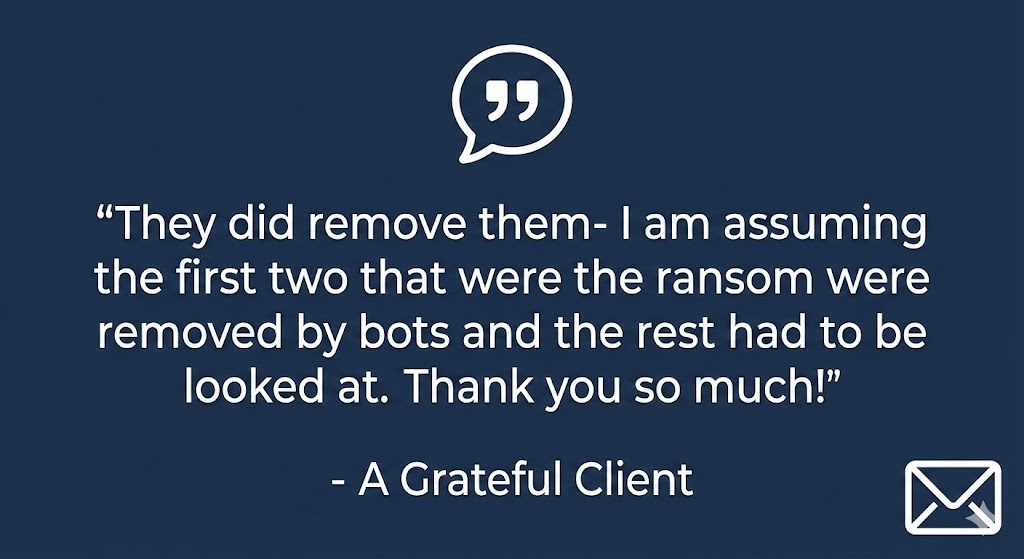
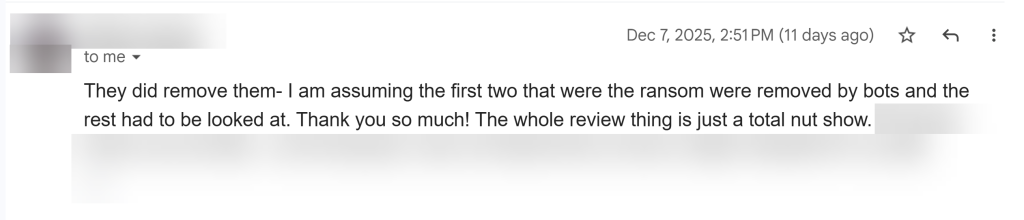
Google’s automated systems likely caught and removed the two most obvious extortion messages first (the ones explicitly asking for contact). The remaining reviews were removed after human review of our merchant extortion report.
How to Protect Your Business from Review Extortion
Know the Warning Signs
Be suspicious of reviews that:
- Appear in rapid succession or at unusual times
- Use generic language that could apply to any business
- Come from profiles with no review history
- Don’t mention specific services, products, or experiences
- Include contact information or requests to communicate off-platform
- Arrive from reviewers who aren’t in your customer database
Respond Appropriately
Do:
- Document everything immediately
- Check if reviewers appear in your customer records
- Report to Google’s Merchant Extortion team (not just flag for removal)
- Post a professional public response explaining coordinated fraudulent activity
- Continue serving your legitimate customers normally
Don’t:
- Contact the extortionist
- Pay any fees to have reviews removed
- Delete your own listing in panic
- Engage in arguments with fake reviewers
- Purchase fake positive reviews to counteract the negative ones
Use the Right Reporting Channel
Most businesses only know about flagging individual reviews. For coordinated attacks, use Google’s dedicated Merchant Extortion form at: support.google.com/business/contact/merchant_extortion
This form requires detailed information including:
- Your business details and relationship to it
- Timeline of suspicious reviews
- Reviewer names and profile links
- Evidence of extortion attempts
- Description of the coordinated attack pattern

Why Professional Management Matters
Our client’s first instinct was correct—she immediately recognized something was wrong and contacted us. Because we manage Google Business Profiles daily, we:
- Recognized the attack pattern instantly
- Knew exactly which reporting channels to use
- Had the documentation and evidence ready
- Responded within minutes, not hours or days
- Crafted appropriate public responses
- Followed up to ensure complete resolution
The difference between DIY and professional reputation management often comes down to response time and knowing the right channels. In reputation management, hours matter.

The Growing Threat of Review Extortion
This type of attack is becoming more sophisticated. Bad actors have learned that:
- Small businesses rely heavily on Google reviews
- Most owners don’t know about specialized reporting tools
- Fear and urgency can lead to poor decisions
- Google’s automated systems can be temporarily fooled
But Google is fighting back with:
- Improved fraud detection algorithms
- Dedicated merchant extortion reporting
- Faster review of coordinated attacks
- Penalties for fake review networks
Final Thoughts
Review extortion is a serious threat, but it’s not unstoppable. With the right knowledge, quick action, and professional support, these attacks can be neutralized before they cause lasting damage.
The key lessons from this case:
- Act immediately when you notice suspicious review patterns
- Never engage with suspected extortionists
- Use the right reporting channels—the merchant extortion form, not just review flags
- Be transparent with your real customers about what’s happening
- Document everything for your report to Google
- Consider professional management for faster response and expert knowledge
Has your business faced suspicious review activity?
The warning signs aren’t always obvious until the attack is underway. Understanding the patterns and knowing how to respond can mean the difference between a resolved incident and lasting reputation damage.
Looking for expert Google Business Profile management and reputation protection? Our team handles hundreds profiles and has successfully fought numerous review attacks. Contact us to discuss protecting your business reputation.